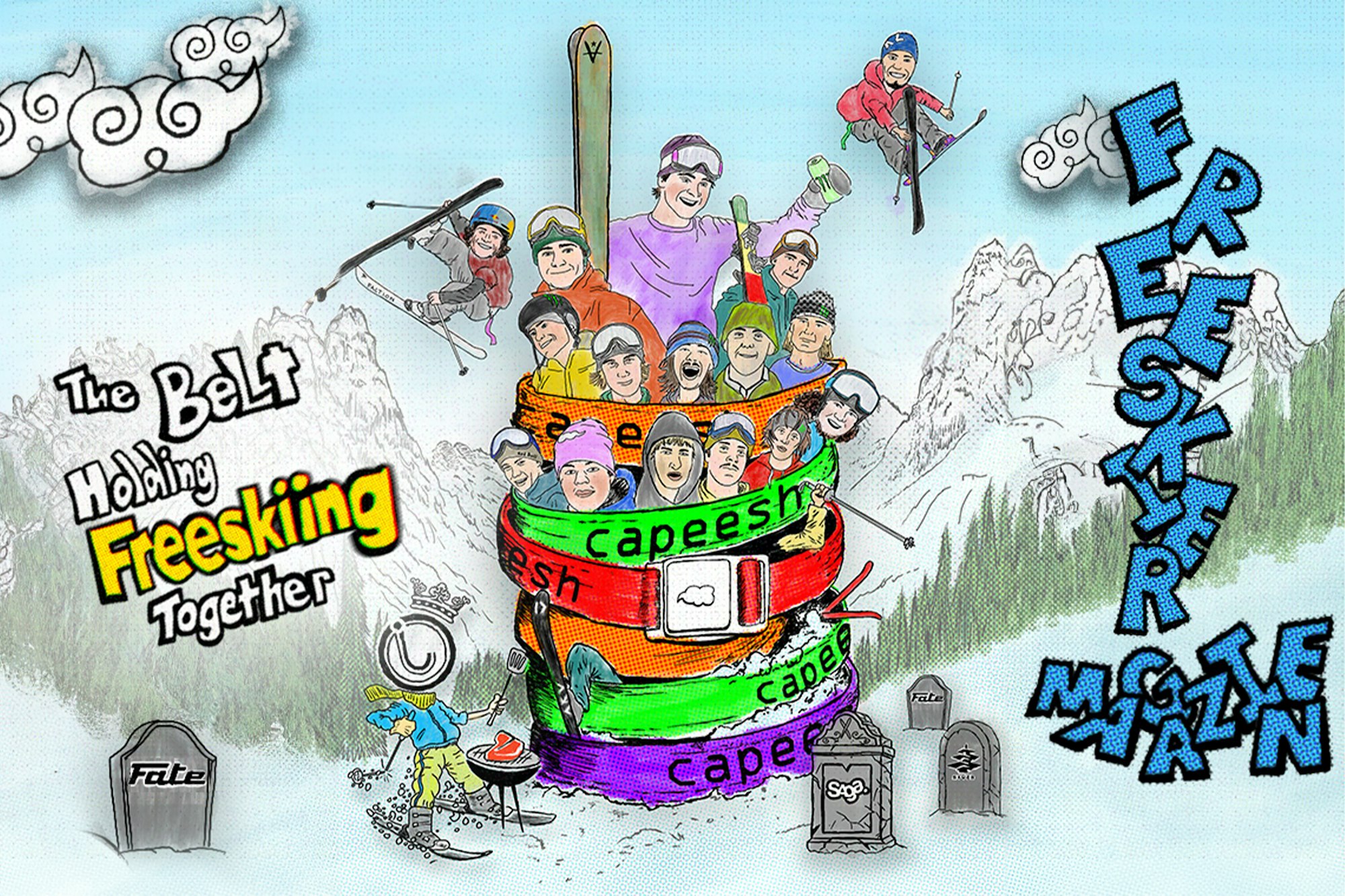
Illustration: Walter Wood
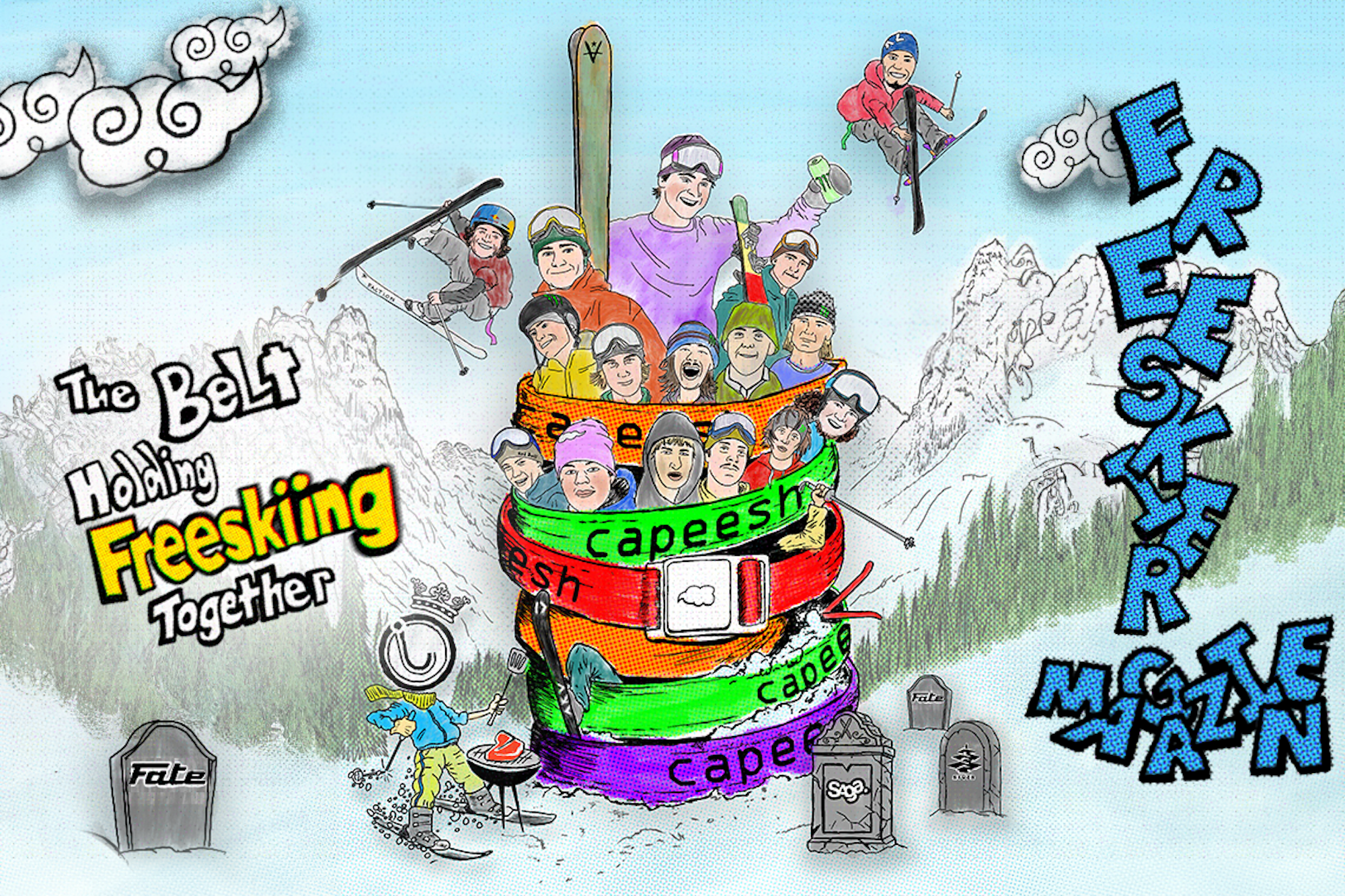
To most people, “capeesh” is slang, a New York deli owner’s way of saying, “Do you understand?” But today it means something else: the hottest ski apparel company since Jiberish’s first oversized hoodie. Capeesh now carries the same cultural weight as Oakley Crowbars, Fate knee patches or Salomon Ten-Eighties.
Skiing has always had a defining silhouette; an image that sums up an era’s soul. The ‘80s had Scot Schmidt blasting powder with a pole plant mid-air. The early ‘90s saw Kent Kreitler’s lu-kangs, then JF Cusson, JP Auclair and Jonny Moseley tweaking mute grabs. In the 2000s, it was T-Hall’s gorilla-stance cork 3 or Candide’s capped tail grab. Today? Many would say it’s a skier mid-air with a “Capeesh” belt swinging from their waist.
The industry has undeniably shifted. Once, an X Games podium could cover an athlete’s mortgage; today, even the best skiers struggle to land contracts. Over time, brands like Fate, Predator, DNA, Saga, Siver Cartel and more, have disappeared, each continually shaping our sport before fading away.
Why? Mismanagement? Seasonal sales cycles? Parent companies draining brand equity? Or us, the consumers, buying from brands with no ties to freeskiing? Likely all of the above. Capitalism feeds growth until brands are sucked dry.
Just look at how you can find Vans in ROSS instead of your local skate shop. That’s what happens when corporations chase endless growth. The cost is everything: financial redistribution, cultural identity and progression. So how do we put the brakes on a runaway ski sliding toward favoring Moncler over ski-born brands? It starts with us, and with Capeesh.
Unlike big brands flashing bonus checks, Capeesh has grown organically, like your grandmother’s garden. Their roster includes Jackson Wells , Matěj Švancer , Joona Kangas , Tormod Frostad , all signed without big money. Why would the best skiers rep a belt, and how can Capeesh compete with giants?
Scarcity from limited releases might create some FOMO, but it goes deeper. Pro-model belts are more than stylish. They are symbols, instantly recognizable and as personal as a signature trick. We saw something similar when Jiberish hoodies defined freeskiing for a decade, but Capeesh goes further. Their founder is a phoenix from the ashes of delaminated edges and Norwegian snus, a humble trailblazer like Eric Pollard skiing switch in powder two decades ago.
That phoenix is Ferdinand Dahl, Norwegian Olympian and co-founder of Jib League. Instead of retiring, Ferdi turned his career into a blueprint for how retired athletes should reinvest in the sport. With friends, he built a brand that skiers are proud to wear. When I asked him at the 2025 Copper Jib League how Capeesh was doing, he shrugged. “It’s good, I guess. I don’t have a benchmark. Skiers like it and that’s all that matters.”
His nonchalant answer spoke truthfully to the brand's nascent manifesto. Capeesh is not chasing sales or market share. Its goal is simple: make products for freeskiers. One belt, one collection, one smile at a time. In doing so, Ferdi may have stumbled into a proven formula.
In any business school or episode of Shark Tank, you’re taught: 1) Solve a problem. 2) Be unforgettable. 3) Make people feel something. Capeesh checks all three.
Their belts do more than hold up baggy pants. They solve real problems every skier knows. Park skiers overshoot landings, and a metal buckle rearranges your insides. Others simply fight sagging ski pants. Capeesh fixes both. The magnetic buckle saves your stomach, and rugged woven materials that could leave Carhartt envious make the strap indestructible.
What sets Capeesh apart is the message. One belt reads “Social Media Ruined Skiing,” a blunt critique for anyone who has seen powder turns replaced by selfies. Capeesh sells more than a product. They sell a position for skiers who value soul over clout, creativity over algorithms, and progression over metrics. Each drop is a capsule of style and a singular voice for the sport. It is intentional, not performative. Their pieces do not just look different; they mean something.
More importantly, Capeesh owns a whitespace in the industry by collaborating with filmmakers and athletes who live, breathe, and are freeskiing today. They do so by honoring skiing’s nostalgia, progression, and joy with campy films by Noah Woodford and Ethan Cook. Edits revive iconic ski movie tracks with raw behind-the-scenes perspectives while their fish-eye lenses feel just a cut away from William Strobeck’s Supreme films, leaving a lasting impression.
Capeesh understands that real influence comes from authenticity, connection, and making people feel something. This is not the kind measured by Kylie Jenner’s follower count or Twitch views. It is the kind that lives in your head rent-free, like park edits burned into your retinas with the crack of an air horn as the Jiberish logo morphed into a camera , or the cursive lettering on a Level 1 shirt. These are the influences that deeply shape a sport and its culture, and they are the ones that last.
Before Capeesh there was Jiberish, and before Jiberish there was ‘Fate’ clothing. The early ’90s freeski brand that pioneered knee patches and side zips, building its own cult following around ski pants. Fate was eventually acquired by Miller International and slowly dissolved into their monotonous portfolio.
Unlike Fate, Jiberish has always stayed independent. It was established by passionate skiers enslaved to Colorado’s I-70 traffic and consumed by the freeskiing movement when Keystone had a 40-foot-tall rainbow rail lit on fire. It began with just three friends crafting clothes, much like Capeesh today. Early support from influential skiers and a roster from Level 1 Productions became the spark that turned the brand into a devoted, almost cult-like following.
Jiberish quickly grew into a recognized name in streetwear, expanding into boutiques in Denver, Boston, and Park City. They spread into skateboarding, snowboarding, and artists, all while supporting skiers, limited releases, and sponsoring events. But that growth came with a lesson: trying to be everything dilutes your identity. By closing storefronts, subjecting the sponsored team to skiers, and making freeskiing-specific outerwear, Jiberish proved that profit follows loyalty and loyalty is longevity. Today, it is stronger than ever, a testament to independence, authenticity, and staying true to its roots.
A brand can stay economically viable without constant expansion by focusing on loyalty, scarcity, and authenticity instead of chasing growth for its own sake. Limited releases, careful product curation, and deep community connections create a sustainable model that rewards devotion over volume. While faceless corporations can drain brand equity, some large brands support a sport’s growth when guided by people who understand and respect the culture. Channel Island Surfboards, for example, has long provided stable sponsorship for surf athletes and events while retaining a cultural voice. Even after being purchased by Burton, it has maintained its independent spirit and continued to prioritize the surf community, ensuring growth does not come at the expense of culture or athlete support.
Capeesh is trailblazing a path few have walked, staying grounded, authentic, and true to its core. But the brand is still young, and there's no guarantee it will last a decade or even another season. The ingredients for its success lie in the support we give and Ferdi’s belief in what he is creating.
I don’t see Ferdi selling his soul to a holding company anytime soon. Hopefully, he has learned from the rise and fall of other freeski brands. Perhaps he witnessed the collapse of Liberated Brands , which once housed surf, skate, snowboard, and ski brands, including Billabong, Volcom, and Spyder; the latter having sponsored Ferdi, symbolized ski culture for years, and was once inseparable from icons like Sarah Burke and CR Johnson in every issue of Freeskier Magazine. Watching Spyder get tossed between faceless holding companies while trying to protect its Venom roots stung, and the pain only grew when someone walked out of Costco carrying a Spyder-branded inflatable sled. Hopefully the brand will turn a corner, and continue with more community-driven collaborations like their project with Elsa Grace .
If Capeesh wants to avoid that fate, it starts with Ferdi staying true to the message stitched into every belt and with us stepping up to support it. This applies to every ski brand trying to stay rooted in the sport, including Spyder, Jiberish, and rising voices like Arsenic Anywhere or Lead Fabrics. It means putting in extra hours at a summer job to afford a $50 Capeesh belt or saving for a $300 jacket instead of wearing a cotton sweatshirt from Champion.
For the parents aging out of the K-fed days, it means convincing your wife that your belt indents on your stomach came from overshooting a jump, not weight gain. For the kids, it means doing everything short of stealing from your mom’s purse. Not for clout or the ‘gram, but because it matters. It keeps freeskiing alive, puts money back in athletes’ pockets, and grows the sport by sponsoring events like Jib League, which can create inclusion and inspire real change in a young skier’s life.
You don’t need to be a K-Fed god or to spin more than a 360 to wear Capeesh. If you’re brave enough to step into the park, to push yourself in whatever way is meaningful to you, or to simply appreciate the beauty behind a Jackson Wells edit, then you belong here.
Support your own. Don’t do it just to be seen. The most important decisions are made when no one’s watching. Do you want Capeesh to be another fad to come and go, or do you want to represent a symbol that stands for something? Support an idea that will raise the next generation, an idea that stands for the soul of freesking. Capeesh?