All Images: Jake Strassman
For 19 seasons, the Line Traveling Circus crew has been roaming the wide world of skiing, documenting their many voyages in their iconic yellow van. Many of us have found a sense of identity through the culture they helped shape and refine, and it's no stretch to say that said culture would be weaker, or at a bare minimum, far different without them. All that to say, freeskiing as we know it wouldn't be the same without Traveling Circus.
There is a near-endless list of people who have helped TC become what it is today, each contributing in valuable ways, from drawings to songs to k-feds. It's like a constantly morphing, slightly dysfunctional, always enjoyable family. But at the core, you'll find Andy Parry, Will Wesson and Jake Strassman.
Parry and Wesson have always skied on their own terms, inspiring others to do the same. Strassman has captured, edited and refined the chaotic vision for our enjoyment. He's the reason we get to go along for the ride. And trust me when I say the latest episode, 19.3, is one that you'll want to join in on.
Here we see the crew back on the East Coast, as Parry, Wesson and Strassman are joined by longtime TC friends Ian Compton and Shane McFalls , along with newer additions Raf Diaz and Lane Brooks . It's a New England adventure packed with some truly incredible riding, along with the same antics that never get old.
Ahead of the release, FREESKIER sat down with Parry, Wesson, Strassman and Brooks to get a few words on Maine, TC's history, the future of freeskiing, social media, ski movies and more. Just in time to stir up some pre-season hype, catch the conversation and the full episode, below.
FREESKIER: Thanks for talking, fellas. This episode has quickly become a personal favorite. I'll start by asking what you find unique about the Maine ski scene? How does it compare to other New England zones?
Andy Parry: Maine makes up nearly 50% of the total landmass of New England, so it's really remote. I think because of this, the community at each ski area becomes very tight. It's cool seeing the little differences in culture at each place. Spruce Mountain, for example, is in a small town about an hour and a half north of Portland. It's an old mill town, and the ski hill sits right near the river. Almost all the features are DIY, and they make do with what they have. Everything from the local skiing style and trick choice to their work ethic reflects this. When we showed up, everyone was ready to grab a shovel. It was a different mindset than the other ski areas we visited because they're working with way less. Long story short, it's cool that each place is different.
Will Wesson: You have to be commited to get outside during the winter being right on the coast. [Maine] has all the ingredients you need for some hardcore skiers who are out there in any condition, always making the best of it. Like anywhere on the East, you can have the best conditions of the season and the worst conditions in one week.
Lane Brooks: Maine has some really dedicated skiers, and the community ties are special in these little mountain towns here. One of my favorite parts is how inclusive everyone is. If you are a new face, or are at the mountain alone, the crews are always welcoming and down to ride. Similar to other New England resorts, we deal with “ice coast" conditions frequently. It takes passion to go out and hike a rail with your friends on sheer ice.
Jake Strassman: They summed it up well. Maine is a gem.
Like you mentioned Andy, a good portion of this episode is shot at DIY setups. Does that up the creative factor and make it more fun? How does it differ from a run-and-gun day filming in the park?
AP : Yeah, the whole feel becomes fun in a different way. Lapping a park all day is great because you don't need to do any work besides skiing. The DIY stuff is always going to involve less actual skiing and plenty of work. It also means longer days, but makes for more interesting shots. I mean, no one would kick you out of Whaleback, a DIY-heavy resort we shot at, because it got dark. They'd probably just get some lights out and keep the skiing going.
WW : It definitely makes things harder, but more rewarding in the end. Having to work twice—first building and moving features and then hiking over and over to get your tricks, takes time and energy. But it’s always worth it in the end. You not only have to think of what tricks to do and how to film them, but also what features to build to bring your vision to life. More steps in the process can help bring out people’s creativity.
LB : Getting the opportunity to have free rein on the local mountain’s stash of features was really cool. It brings back a sort of childhood backyard feel of creativity. It’s sweet getting the chance to set up something that emulates your riding style. That said, I love taking hot laps in the park, too. When you pull out the camera, it’s really easy to get lost in the vibe—just having a good time with your friends, almost effortlessly hitting a flow state.
JS: DIY situations are probably my favorite thing we get to do in LTC. The whole process slows down and we get to focus on being creative and filming something with purpose, rather than just filming on park features that have been hit a million times before. If I’m lucky, I sometimes get a chance to create a feature that the other guys want to hit and get clips on, which is another cool way to contribute to the video. As a filmer, I have more time to dial in my shots, too.
With such a variety of features, DIY and park, which was your favorite feature and trick from the episode?
AP : I really liked everything Raf [Diaz] was doing at Whaleback. It was filmed really well, and it's hard to tell what's going to happen next.
WW : I loved the roller coaster rail at Sugarloaf. That whole park was fantastic. My favorite trick someone else stomped was either Raf grinding a random tree at Sugarbush next to a perfect park of rails, or Lane's switch cork 5 knuckle thingy at Loaf.
LB : Getting the chance to jib the lift chair at Spruce Mountain was a highlight of mine. Doing the nosebutter cork seven off the knuckle at Sugarloaf felt really good. That’s easily my favorite trick to do when the snow starts softening up. I was really hyped to see Gabe get his front 270 hand drag on the up-tube-knuckle at Sugarbush.
JS : I am a fan of everything that went down on the DIY setup at Whaleback Mountain. Filming Raf that day was my highlight for sure. It was so sick to see his creativity and unique tricks on obscure features. Pretty much all of the tricks from Raf and Sawyer that day were my favorite.
When the dust settled, what was the total of lobsters put away for the crew, and who had the personal record?
AP : I think it was just the two lobsters when we went out one night. It was actually difficult to find live lobsters because they aren't in season during winter. I'd never thought about eating more than one lobster at a time because they're generally really expensive. I'm also not from Maine, so it's not in my DNA.
LB : As the resident Mainer, I probably have the personal record. Growing up, my dad and I kept five recreational lobster traps. We’d set and haul them from spring to fall just for fun. We couldn’t legally sell what we caught, so we had lobster for dinner a lot. I’ve definitely eaten three or four one-and-a-half pound lobsters in one sitting. I wouldn’t be surprised if I’ve had a couple hundred crustaceans in my life.
Jake, Will and Andy, you've seen so many corners of the freeski scene in the States over the years. What still surprises and inspires you? What do you see that's different now than things were 19 seasons ago, for better and for worse?
AP : Seeing all the dedicated people at each ski area is inspiring. A lot of the time, you can get jaded. So when I see the younger generation holding it down and doing the same shit I would have done 25 years ago at 15, it inspires me. I think the biggest change we've seen is how media is consumed. We grew up watching ski movies on VHS and DVD. A friend would get one, and we'd all go over to their place to watch it.
When we started [Traveling Circus], that had just begun to change, and it rapidly evolved into the media environment we have now. It's good and bad. I think it's been part of the accelerated pace of progression over the last decade. However, I'm not sure that progress is necessarily good. Luckily, we have Torm .
WW : I’ve always been inspired by the stoke level of skiers at the small hills in the East and Midwest. Making the best of whatever conditions are is the name of the game. I think nowadays, people are more susceptible to the fomo generated by social media and sometimes expectations are set too high, which leads to disappointment. Along with that, phones create such a big distraction, which we are all guilty of. It really contradicts why most of us go skiing in the first place. It's nice to just leave the phone in the car sometimes.
JS : I’m impressed by how strong our freeski niche of the sport is. In every corner of the world, we meet so many people that are so deep into the culture—like, a surprising amount.
One thing that’s changed over the years is the sheer volume of video content being put out. It’s hard to keep up with it all if you don’t try hard. Where we used to have one Level 1 and one Poor Boys movie per year, now we’re spoiled with tons of videos from every sub-genre, location and level of skiing. There are good and bad aspects about that, but as a whole that’s a pretty big success story for video and filmmaking in freeskiing.


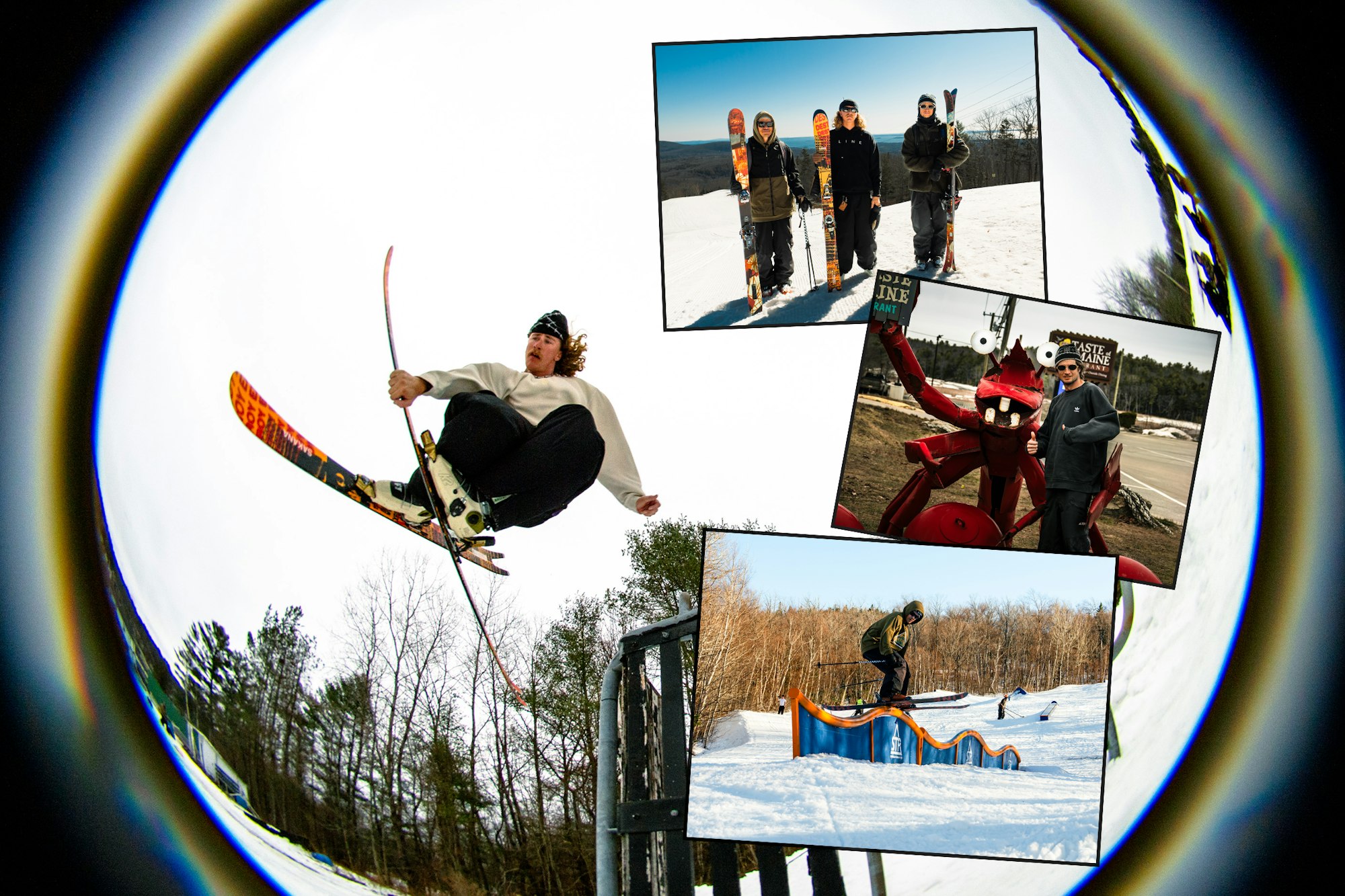
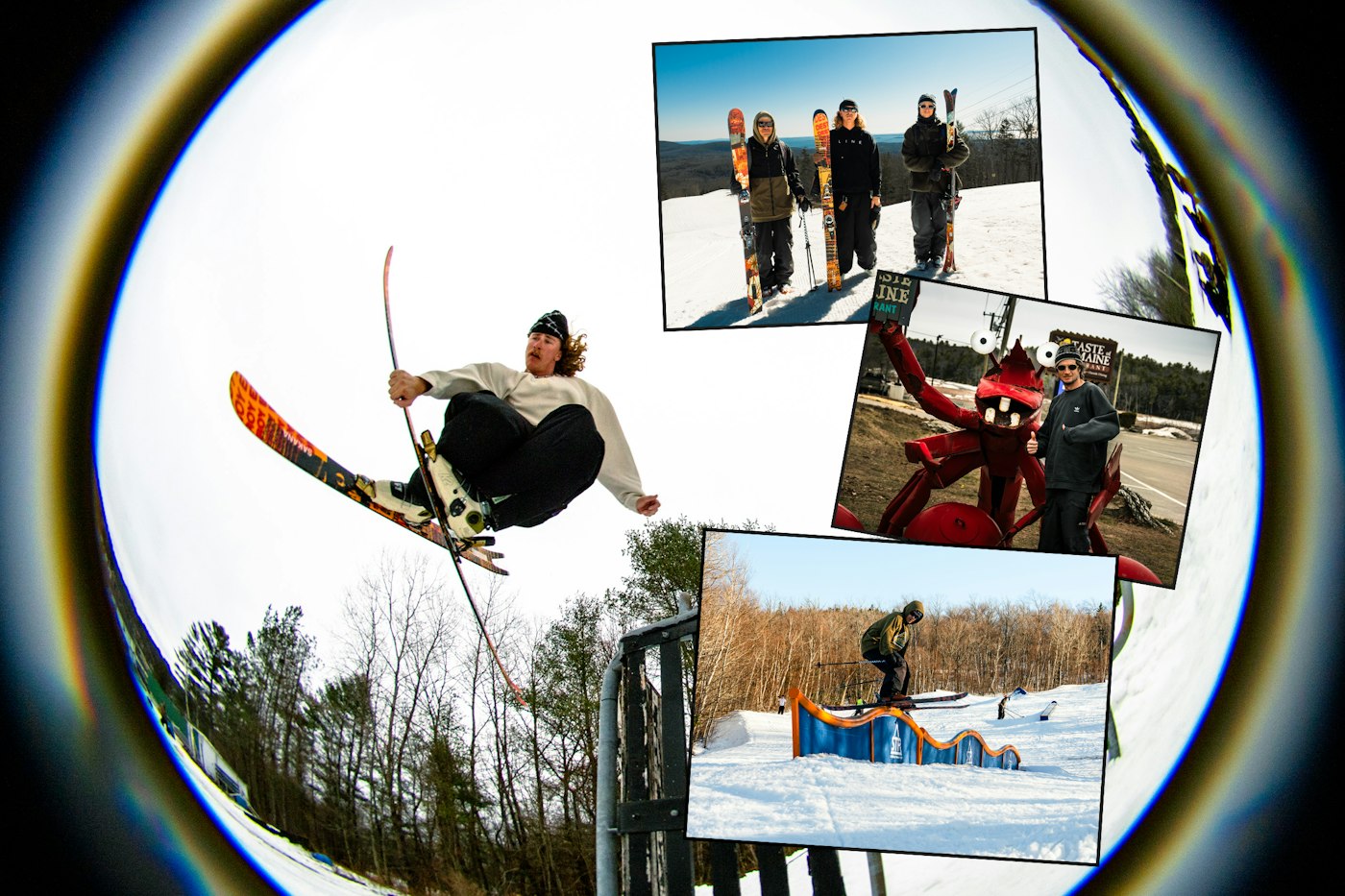
Parry, Wesson and Brooks pose next to Maine's finest traps (left)
Wesson tames a lobster-branded tube at Camden Mountain (right)
Speaking of change, it wouldn't be hard to argue that between access and affordability, skiing is at a bit of an inflection point. Do you agree with that, and if so, what can we do to help bring skiing into a brighter future?
AP : Skiing is no doubt getting more expensive, but people are still skiing. Excluding last year (thanks to a horribly low snow year), the past five years have had record skier visits in the USA. People are still finding ways to make it happen, but for how long, I'm not sure. I think if smaller ski areas can keep it affordable for kids to learn, things will be okay on a local level.
The big-time destination resorts might not be okay, though. If we have two or three bad winters in a row, that would probably be a death blow for some of the larger ski resort conglomerates. Ski areas that haven't found four-season revenue are also going to be fucked. All that to say, keeping it local is a great way forward, as I see it.
In your eyes, what makes TC a success? Has that changed over the years?
AP : I think it's a combination of things. One is our consistency over the years. People generally know that TC is coming out in the fall, and it's going to have a somewhat familiar cast of characters. Another factor is how relatable our episodes are. Yeah, we might be in Switzerland, for example, but we're skiing on PVC tubes and logs in the woods. Most of our episodes could be done by anyone. They're road trips with your friends.
WW : When TC began, the only real goals were to ski a bunch of new places with our friends and make videos that showed how fun that was. All that kept things relatable to the average park skier. There have been many times over the years when I asked myself, “What am I doing with my life?” But the insane, joyful response we get from the skiing community helps remind me that those original goals were pretty spot on, and that we should keep going.