
[juicebox gallery_id=”221″]
When he was 7 years old, Karl Fostvedt’s family flipped a coin.
“To determine whether I was going to join the ski team or the snowboard team,” he says.
“They just flipped a coin, and it landed heads, so I joined the ski team.” I breathe out, forcefully through my nose, incredulous.
“You’ve got to be kidding me,” I say.
“I kid you not,” he responds. “They just flipped a coin.”
With four brothers, two half and two full, who are all snowboarders and a sister who skis, joining the ski team made Karl Fostvedt the odd brother out. But a single coin flip doesn’t guarantee anything, certainly not the success that Karl has found in the ski industry. Seventeen years later, Karl is on the leading edge of our ever-evolving sport. He’s featured in movies from Poor Boyz Productions , Teton Gravity Research , 4BI9 and Sweetgrass, including inimitable segments from locations like Detroit (with Poor Boyz) , Sarajevo (with a 4BI9 crew contracted by Teton Gravity) and a nearly snowless forest in Washington state (with Sweetgrass). Last winter also brought contest success for Fostvedt, who stood atop the podium at War of Rails and finished second at Total Fight Freeski and third at the VARS Tournament. All the while, he has been juggling schooling; he’s about to finish a degree in Environmental and Sustainability Studies at the University of Utah.
Stylish, confident, talented. Those are all qualities that make the world of ski media take notice. Thoughtful, humble, independent. These virtues don’t always guarantee attention. In my mind though, Karl is next in a line of skiers who combine both sets of traits, indelible names in our sport including Eric Pollard, Michelle Parker, Dash Longe, Pep Fujas, Mike Hornbeck, Adam Delorme and more, all who have made their names not by scoring higher but rather by playing an entirely different game.
Skiing is a fickle sport. Skillful skiers toil in anonymity—they blow minds on their local terrain but never make a dollar. Daredevils with generational skill never share their talent beyond a local resort’s website. Every once in a while, though, a small window opens, and if the constellations of talent, desire and luck align, a new athlete ascends to a higher level.
Watch: Poor Boyz Productions’ shreds Detroit.
In the fall of 2013, Karl made that leap, winning Rookie of the Year honors at the iF3 Film Festival. In February of that year, snow was falling on the Front Range of Colorado, and Pete Alport, who was filming with Poor Boyz, was driving in a raging blizzard, keen to take advantage of the conditions. Poor Boyz’s standard street-skiing crew was unavailable—filming elsewhere or dealing with the pain-in-the-ass travel circumstances inherent in a life always traveling into a storm. So Alport called me and instructed me to watch some videos of a new kid who might perform before the cameras until the others arrived. I hadn’t met Karl yet, but I had already seen most of the clips. They showed pure skiing talent, sure, but until you see firsthand how a person deals with the ups, downs, pressures, failures and successes of a shoot with the likes of Poor Boyz, there is no guarantee that they’ll mesh with the crew.
Karl got the green light. The first feature I saw him hit was a closeout rail with a gap over another rail to a flat landing. He nailed it. We hit another couple of spots that day and built a monstrosity of an up-rail setup that went untouched, due to a hundred horse trailers being parked on the in-run when we arrived the next morning. Skiers Leigh Powis, Sean Jordan, Matt Walker and another filmer, Cody Carter, joined up, and over the next four days, Karl put together the foundation of the segment that would earn him Rookie of the Year distinction. He shoveled snow, told jokes, attacked sketchy features without acting scared, worked hard, stomped tricks, talked philosophy, nerded out about skiing and never got down (for more than a few minutes). He was the new guy, so he guinea-ed most of the features without complaint, including overshooting a big rainbow ledge and a step-down jump off a barn roof, both to flat landings. Karl joined Poor Boyz on
a handful of trips throughout the season and quickly graduated from rookie to regular.
Watch: Karl Fostvedt’s Topless Loop.”
“We could tell early on,” explains Karl’s half-brother Hans Fostvedt, “just by the mischievous looks that the kid would give us, he never was really scared of anything.” Hans is emphatic as he tells the story of Karl climbing a bookcase during a ski trip to Oregon and falling face first. “He just falls down, completely hurts himself and gets back up and starts climbing again like it’s nothing. That’s when I knew that Karl was different from the other kids.” Hans explains that the courageous streak was something more than just showing off. “He was always trying to be his own person, to do his own thing and be independent from the family.”
For all the independence exhibited by a skier who has made his name by going places outside the mainstream of skiing, Karl still arrows every conversation back to his family and mentors. As we wrap up an interview, he pleads with me to speak further with his brother, who is also his ski coach and the owner of the local sandwich shop in his hometown, Ketchum, ID. Somehow, in spite of his achievements, Karl still feels awkward discussing his own talent.
Today, Karl is sponsored by a range of companies, from anon. for eyewear to Dakine for accessories to Full Tilt for boots and even Tree Fort for the travel wallets always strung around his neck. He has a pair of pro-model skis with ON3P, and this is the most obvious association of his career, although the relationship didn’t come that easy. After hearing about Karl way back when, Scott Andrus, the owner of ON3P, tried to track him down. “We hadn’t heard from him in a while,” he says. “Finally I sent him a message on Newschoolers.” That did the trick.
“You see kids with a lot of talent, but they’re [not always] the ones who are on fire for it. There’s no such thing as a bad day skiing—of course that’s a contradiction—and [Karl has] always had that mindset.”
If you search online for videos of Karl skiing, an apparent starting point comes when he moved to Salt Lake City in 2009 for college. His style, even then, is unmistakable—even if he’s wearing an ill-fitting jacket and unstylish helmet and skiing on borrowed backcountry skis. When ON3P first partnered with him, it was because of that. “I always tell Karl he skis the way I wish I could,” explains Andrus. “He just has a really unique style, and you don’t see a lot of people doing the stuff he’s doing, in terms of body positioning and grabs.” Still, talent alone doesn’t guarantee great achievements in the ski industry.
How does a skier “make it”? Talent, yes, but the other side of the equation is passion. Ryan Dean was one of Karl’s coaches at the Sun Valley Ski Education Foundation, the team that Karl landed on after the coin flip. “He was one of those guys who was totally into it, totally stoked and willing to send it,” says Dean, whose grandfather’s name graces Sun Valley’s Proctor Mountain and whose own children are some of the only sixth generation skiers in America.
“You see kids with a lot of talent, but they’re [not always] the ones who are on fire for it. There’s no such thing as a bad day skiing—of course that’s a contradiction—and [Karl has] always had that mindset.”
Both qualities, talent and effort, dovetail well with how he acts. Diving in to score a touchdown, catapulting a soccer ball into the top corner of a goal, throwing down a poster-worthy dunk: mainstream sports media loves to say that an athlete should “act like you’ve been there before.” And regardless of personal experience, Karl acts like he’s done it before. From the first day I shot with Karl, though, those exclamations of success have always been tempered by his actions. Karl lands the trick, kicks off his skis and asks what he should do next.
Last February on a trip to Sarajevo, I shot Karl as the sun went down over an abandoned hotel. I showed a photo to him. His body was stalled high on a wallride, and his shadow marked the wall of the ruined building. The random details of a photo shoot surrounded a pool of standing water in which the camera captured the reflection of his body. It was as good as any photo I’ve made in my career. He seemed pleased, but the next day our crew went back to the feature, and Karl was smashing his skis into the wall and eventually got a better trick on video with a photo to match.
This single-minded dedication to skiing bears itself out in other ways, too. I see it on Karl’s Facebook page where, unlike other pro skiers, he mostly shares videos of other people skiing. When I ask why, he explains that he doesn’t get tired of watching skiing. “I like being a portal,” he tells me, “a place to scroll through and see what other people are doing and what I think is cool.”
Karl’s brother Hans grew up in Santa Barbara, CA, during the days when skateboarding became the new surfing, when cool became cooler. At age 10, Dogtown skateboards sponsored him. He’s got a long history of studying style and those who want to appropriate style. As he tells story after story about his younger brother over the phone, Hans asks me a question: “Can you hold on one second, brother?” Hans begs for a few moments to catch his breath. “Sorry, man, I just took this long hike with my dog, and we’re up here on the top of this ridgeline over Sun Valley . It’s real beautiful. I’m making unwise oxygen choices.”
Hans admits a family bias towards Karl’s skiing but is crystal clear in his judgment. “I can watch his videos,” he explains, “then watch a great legend like Christian Hosoi on a skateboard and go, ‘Wow, my brother has got the essence of what it takes to just be fucking awesome.’”
“He went on his own path and decided he was going to do all this radical stuff,” says Hans, before explaining that, in spite of the Norwegian, blonde, tall physicality of their family that implies simplicity to the casual observer, there is something more to each member of the Fostvedt family. It is what Karl embodies. “If you go deeper, he’s a rebel intellectual. I encourage him to be himself at all cost.”
Whether it’s in the backcountry or on street features, Karl’s career is built on his tricks and the way he does them. That all goes back to the coin flip and to his family. It goes back to Ketchum and skiing Sun Valley. “I was lucky as hell to be able to ski every weekend,” Karl tells me of joining SVESF as a 7 year old. “By the time I was in sixth grade, I got out of school early, four days a week, to ski. Since finishing school he’s been skiing six days a week. I think anyone that’s skied as much as me would be as good at skiing as I am or better. If you do something long enough, you’re going to get good at it.”
Hans explains that Karl’s talent comes from more than just time on the slopes. “I told Karl a long time ago, anybody can go out and do a hard trick, but if you can do that trick and make it look smooth—if you can flow like water, if you can add style to your trick— you’re going to bring art to skiing.”
Watch: Fostvedt and friends throw down at Windells.
That idea that skiing is about doing things differently rather than just going bigger has been in Karl’s head for quite some time. At Windells Camp in July, I watched as Karl found a natural takeoff on the left side of a tabletop, launched himself into the air and landed on the lip of the kicker stationed in the center. He tail-pressed his way across the entire flat, foot-wide lip before transferring down to the tranny on the skier’s-right side of the table. It was not exactly photogenic, but it was special and difficult, a line as much for his enjoyment as for photos or video.
Eventually, he completed the stunt to his liking, but his best iteration never appeared in a major film. I’m not sure he cared. “The sad thing is that it’s kind of effortless for him,” says Hans as he catches his breath above their hometown. “The best thing is he’s using his God-given talent to the fullest.”
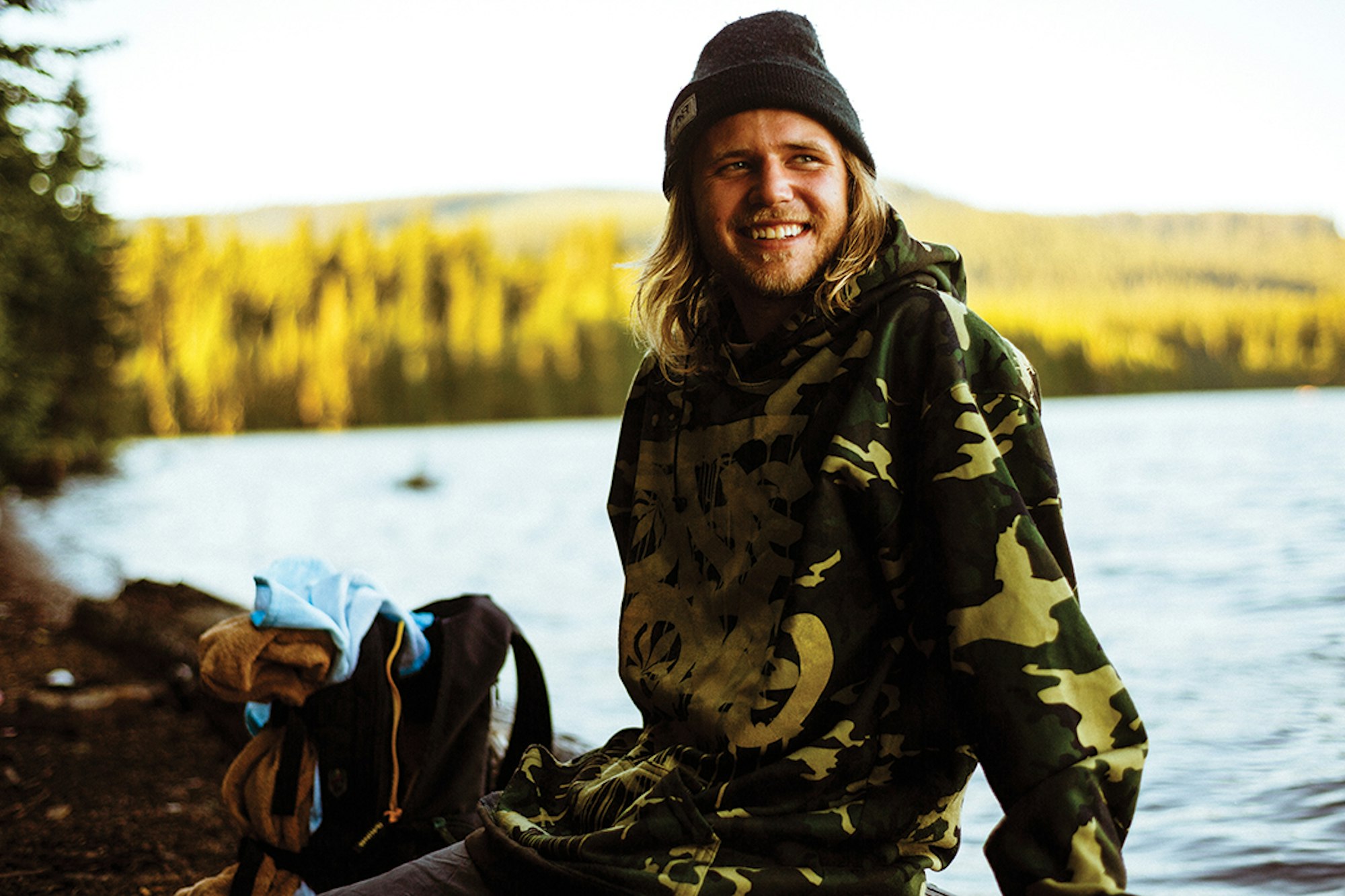
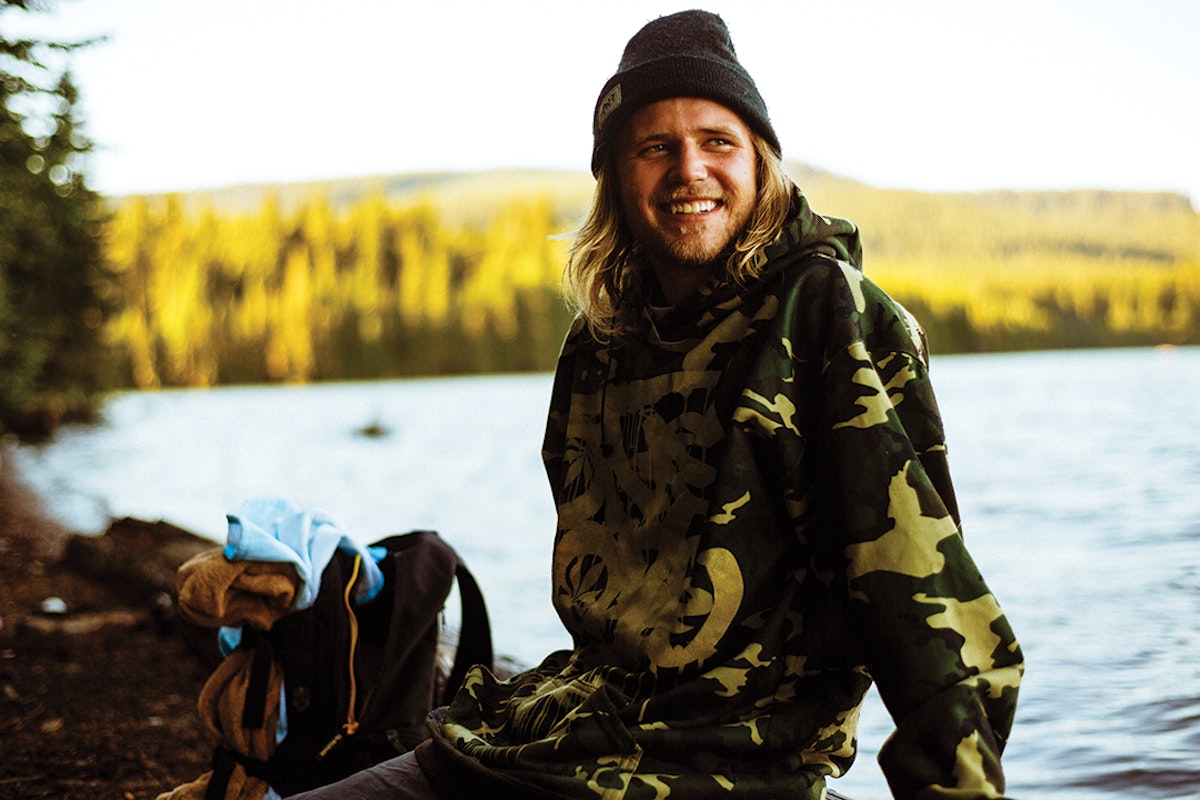
After wrapping things up at Windells, Karl and I made our way to a lake about 30 miles from Mt. Hood. We wandered the shoreline, looking for a spot to shoot a portrait. Karl sat on a log with the calm water behind his back—a forty, a bag of chips and a bottle of salsa lay just out of the picture. As much as I asked Karl about his career, his history and his thoughts, he deflected and talked about other skiers, moments in skiing and the way the ski industry already is. Mostly though, he wanted to find the sun. He wanted to find a spot to camp. He wanted the sun on his face and the water at his feet and no camera pointed at him. He smiled and chuckled as we walked through the woods. When we got back to the parking spaces, he told me to follow the car he was in, but eventually I lost him. Karl went off to camp in the forest beneath the stars. He was hanging with a Scandinavian ski crew dubbed The Bunch . They had a compound in the woods where there was no cellphone service.
When Karl and I finally catch up a few months later, he has just returned from a month in Spain, hanging out with a friend, Luka Melloni, who builds skateboard parks. Karl talks about doing a park shoot with features that are smaller but more technical in nature. He also wants to hit Chad’s Gap this winter. “More than anything, I want to focus on building it as good as possible,” he tells me, expressing appreciation of the attention to detail shown in Spanish architecture, “even if it takes two weeks.”
“I want to see how far we can build the shelf out,” Karl explains, “so the gap’s a little shorter but the jump’s kickier and we have more hang time than in the past.” The ultimate goal is to hit the jump enough to get comfortable and, although he won’t tell me the specifics, put down new tricks. Intent on redefining one of the sport’s most iconic jumps, Karl has a bigger view of our sport.
Even though he lives in Salt Lake City and travels the world, seemingly without a break, each time I speak with Karl Fostvedt, Ketchum comes up. His family comes up. It seems odd to say this of a skier who grew up in a town as ingrained in ski culture as Ketchum, Idaho, but Karl was never given a free pass into the skiing elite.
Karl’s vision of that town is his brothers. It’s his first memory of being on skis, intimidated as he watched faster skiers zoom past. It’s Johnny G’s subshack and working in the auto-body shop owned by his coach at SVSEF. Karl tells me to talk to these people, and they tell me about Karl. “There’s definitely nobody that I know who loves skiing more than him,” says Johnny G. “He’s got the needle in his arm, for sure.”

Note: This article appears in FREESKIER magazine Volume 17.6. The issue is available via iTunes Newsstand. Subscribe to FREESKIER magazine .
Related: Karl Fostvedt has been crushing Japanese pow this season