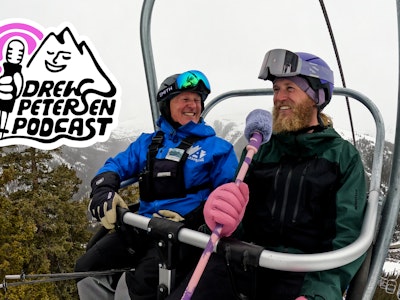


Featured Image: Ryan Schrader | Speaker : Drew Petersen
It's easy to avoid the mental health crisis on the surface. That's what makes the situation so discrete, yet so palpable... and dangerous. It's easy to avoid the hard truth that the Rocky Mountain region of the U.S. faces suicide rates two to three times the national average, according to research done at the University of Colorado Boulder. But it is not easy to deal with the reality that everyone knows someone who is suffering. That's why individuals like Drew Petersen are a shining light in the wide world of skiing, and far beyond.
Over the past few years, Petersen has been persistently vocal about his personal struggles with depression. He's shared written words, given public talks and crafted movies all with one goal: to normalize the conversation around mental health, and forge a better way forward. Along with films like " The Paradise Paradox " and " Mountain in my Mind ," Petersen has been a guiding force in a movement that's spread rapidly and given a spotlight to this ever-important issue.
But if you've seen his channels recently, you probably know that he's taken his message to more mainstream stages, literally. Petersen gave a powerful speech last winter at a TEDx event in Breckenridge, Colorado, recounting his own story and delivering a staunch reminder that these problems can't be solved in a single day, and that that's okay. Rather, he tells us to just do the little things, talk to friends, and make space for vulnerability.
As September is Suicide Prevention Month, we thought it fitting to get a few words from the man himself on his recent endeavors. From everyday tips to long-term resources, look below for FREESKIER's latest chat with Petersen, as well as his full talk from TEDxBreckenridge.
FREESKIER: A big part of your story and this TED Talk has to do with asking for help. What are the social (or other) factors that inhibit people from asking for help, and how can we better topple them?
DP: There’s still a stigma surrounding the need for help and a belief that seeking help means you’re flawed. Moreover, a belief that it's a bad thing to be flawed. There’s a burden, or wall, of shame that comes with that belief socially. But we’re all flawed; that’s part of what it means to be a human being. Once we can accept that, it’s a lot easier to accept that we all need and deserve help.
Parallel to that is an infatuation with “being strong” in our society. But real strength isn’t pushing through; it’s knowing when to push through, when to ask for help, and then actually doing so. Shame thrives in silence and darkness, as does stigma, so we need to bring all this out in conversation to normalize it. Asking for help normalizes it for others to do the same. Of course, there are also factors that are systemic, financial, and individual-specific. But I hope that chipping away at changing the culture will help those, too.
How do you hope people walk away from your TED Talk feeling?
In a broad sense, I hope that people feel empowered to take better care of themselves, but also to take better care of those around them. To be specific, I hope people feel empowered to ask for help. I think conversations around mental health and around suicide prevention can feel overwhelming and intimidating for a lot of people. But I hope that in the days after listening to my talk, people feel like the conversation around mental health is a lot more human and approachable overall.
Your film, "Feel It All," speaks on the importance of accepting both the low and high points in life and learning from both situations. What advice do you have for someone who is stuck in the low points?
I’ve found that the less I fight those lows, and the more I note, accept, and move through them, the easier they pass and the better I understand the cycles that create them. This seems to give those [low points] less power over me. But that takes practice, and practice can mean going through it. The low points are where the magic lies, and while that’s hard to believe when you’re in them, it pays off in the long run.
Personally, it’s kind of wild to watch " Feel It All " now, three years removed from production, because of how much I’ve grown as a human in the years since. I’ve put in a lot of reps of that exact practice I’m talking about. Holding everything a little more lightly, including the lows, highs, and in-betweens, continues to help me get better at it.
What is a tangible thing someone can do today, this week, or this month that could make a difference in the current mental health crisis?
The solution starts with talking about it, whether that be on an individual or community level. Maybe for you, that looks like asking for help as I speak to in the TED Talk. Getting that help for yourself or one friend counts as a real difference in the state of mental health. Or maybe, today, that looks like opening some space for a conversation. That’s something that anyone can do, any given day. Take the time to ask someone how they’re really doing and give them the space to honestly answer.
Making a difference can also be as simple as sharing an article or film with your group text or with one friend and opening up to them, explaining why it resonated with you. All of that seems small, but those steps are how we build practice reps, create space for vulnerability and further the ripple effect of positivity.
What's a great organization in this field that you think readers should know about?
One nonprofit I really enjoy working with is The Speedy Foundation . I would love for more people in the ski community to be aware of their work, as the foundation was created in memory of aerials skier Jeret "Speedy" Peterson. Their work is largely in the Mountain West, but it’s relevant everywhere, and proves that education, awareness and accessibility to mental health training and resources saves lives. I worked with them to bring "Feel It All" into schools and the broader community in North Lake Tahoe last winter, and we’re hosting a similar series of events for both schools and the public in Boise, Idaho , this fall.
Progress can be tricky to describe. How do you think we'll know when we've made progress in the world of mental health and suicide awareness? What are the everyday indicators we can look for?
Progress can be both subjective and objective, but it’s always gradual. But by and large, we’re definitely making progress. I mean, right here, right now, a skier is reading this article on Freeskier. That didn’t exist when I was a kid growing up within ski culture, and now it's commonplace. That may seem subjective, but it’s tangible, and I have to believe it matters.
Objectively, we can see progress in some areas by looking at the data. In 2024, the suicide rate among youths [aged] 10-18 in Colorado was at its lowest level since 2007. Unfortunately, that kind of progress definitely isn’t true across the board, but that recent improvement in Colorado is a result of both proactive and reactive initiatives that are clearly working.
On an individual or personal level, I think a simple, but huge, indicator of progress is asking ourselves, 'What does it make me feel when I come across the topics of mental health and suicide?' Understandably, it makes a lot of people uncomfortable, and that isn't a bad thing by itself, but it is if that uncomfortable feeling keeps us from talking about these issues. I think we’re starting to normalize conversations around these topics, and that's a big step in the right direction. If we’re all getting a little more comfortable speaking out and, importantly, asking [for] and giving help, that’s in my book, progress.