
[juicebox gallery_id=”325″]
Note: This story was updated on August 9, 2016 to include Good Company’s Vice Versa trailer. The article appears originally in FREESKIER magazine Volume 18.5. The issue is available via iTunes Newsstand. Subscribe to FREESKIER magazine .
Early one clear morning last spring, I pulled into the parking lot at Seven Springs Mountain Resort in southwestern Pennsylvania, about an hour from Pittsburgh. The road to the resort wove through tightly packed hills and valleys covered with thick trees, but now I could see a few lifts and wide trails rising above low flatlands to the east. I was meeting a big crew of skiers who had gathered to film for Good Company’s Two , the second release in the simply named web series produced by Tom Wallisch and his agent, Tom Yaps.
The directors, AJ Dakoulas and Kyle Decker, are longtime collaborators with Tom on video projects for 4bi9 and Level 1. Decker also directed The Wallisch Project , which was released in 2013, a concise and unrelenting eight-minute video—all Tom and all banger action. Good Company’s new webisodes, however, are expanded to include some of the friends Tom skis with on a regular basis.
One and Two , both released in 2015, incorporate more context as well as more skiers. Over about 30 minutes total, the editing seamlessly transitions from street features to backcountry to terrain parks. Any break in the A-plus action is as much a chance to catch your breath as it is an opportunity to introduce the setting.
The trailer for Good Company’s new film, “Vice Versa,” released on August 9, 2016.
Late one night during the shoot, Karl Fostvedt succinctly explained the overriding philosophy behind Good Company’s latest releases, “Show skiers in their element, doing what they do best.” No matter if it’s a knuckle trick, big wall ride, rail or monstrous kicker, the action is self-judged with the most critical eye. If any single skier does not stick out as better than everyone else in the edits, neither is there a weak link. This company is good at skiing.
The wordplay isn’t exactly subtle. “Good” is a quality. “Company” refers to either companionship or business. But within the financial connotation, another level contains more than a spoonful of sarcasm. Has this one-time underground skier sold out? It’s a touch that might come off as disingenuous if Tom wasn’t so damn wholesome.
A few nights after I arrived, the motor drive on my camera clicked away as Tim McChesney slid on his side down the landing of a large man-made jump. I knew the photos would be deleted, yet a feeling of respect for the greater story held my finger on the shutter release button until he came to a stop.
The skiers and filmers formed a group around McChesney, just off the snow where he had dragged himself to catch his breath. “I can’t believe you didn’t break at least your collarbone,” Tom said with a shake of his head.
“I’m built like a strong bull,” was McChesney’s wry reply. After a few minutes, everyone crowded close to the small screen on a video camera to see what had gone wrong. Instead of being downcast, cheers erupted. “Get back up there,” shouted one voice over the rest.
Finally, the chatter tailed off. “If I would’ve gone a little bigger,” McChesney mused, “I think that would’ve worked.”
“You came around a little late,” observed Dakoulas before Tom chimed in again.
“It’s a high-consequence trick, if you come around a little late …” He left that thought in the air, his head again moving from side to side.
Over the next few minutes, various conversations rose up then faded away. Should Tom Arnell—one of the filmers—do a triple shot of Everclear as he’d vowed to if McChesney landed the triple, even though the trick wasn’t stuck? And how close was Tim to getting the trick, really?
What about the top-to-bottom dirt patch some of them had been eyeing up on another run? Ripping down the brown would be high consequence as well but perhaps more entertaining than a triple flip. Through all the banter was the rumor of a snowboarder doing a quad cork and video of that trick surfacing online. Finally someone pulled it up on a phone.
“It’s just not snowboarding anymore,” Tom declared as we all leaned in to watch.
“Of course you can do a quad flip, you’re an Olympic gymnast,” replied Dakoulous. “You can probably do that on the floor of a gym.”
“But did anybody see the penguin danceoff video GoPro posted? ‘Cause it is adorable!” exclaimed Tom with natural, low-key, uninhibited jocularity. And that’s maybe why he is the future and present face of skiing. It may have been just a moment among friends, and he’s talking about one of his sponsors, but it was clear that his sarcasm wasn’t negative. It was an honest acknowledgment that he loves penguins and that, well, dancing penguins are cute as hell. And, oh yeah, you can film anything with one of those ubiquitous cameras.
As the drumbeat of the penguin video ended, Tom declared that the penguin video was “way more fascinating” than a quad. And still, the conversation circled back to corking.
“I cannot imagine doing another flip,” replied McChesney. At this point, he wasn’t fighting to catch his breath, just reclining on the slope of the hill with the jump behind him.
“Do you see how right away that first flip is done?” asked a voice from the fringe of the group. “That’s why snowboarders triple so much easier than us.”
McChesney asked if he was bleeding. “Yeah,” I responded. “Just on your forehead where your sunglasses hit.”
“I will say, that’s the…” someone began, before Tom finished the thought, “…first triple done in a ball cap and sunglasses.” The circle of friends laughed as one.
“Should we take a break and come back for a sunset sesh?” inquired Tom. His voice was assured, friendly and calm. If someone had spoken up and said they wanted to ski, if they named a trick they wanted to film while the landing was slushy, everyone would have fired right up. But Tom’s opinion was clear. The crew had already pushed their skiing towards the edge of what is doable; John Ware was injured in an unlucky circumstance, and Tim got shook really going for it. It was time to relax and eat some snacks at the bottom of the hill.
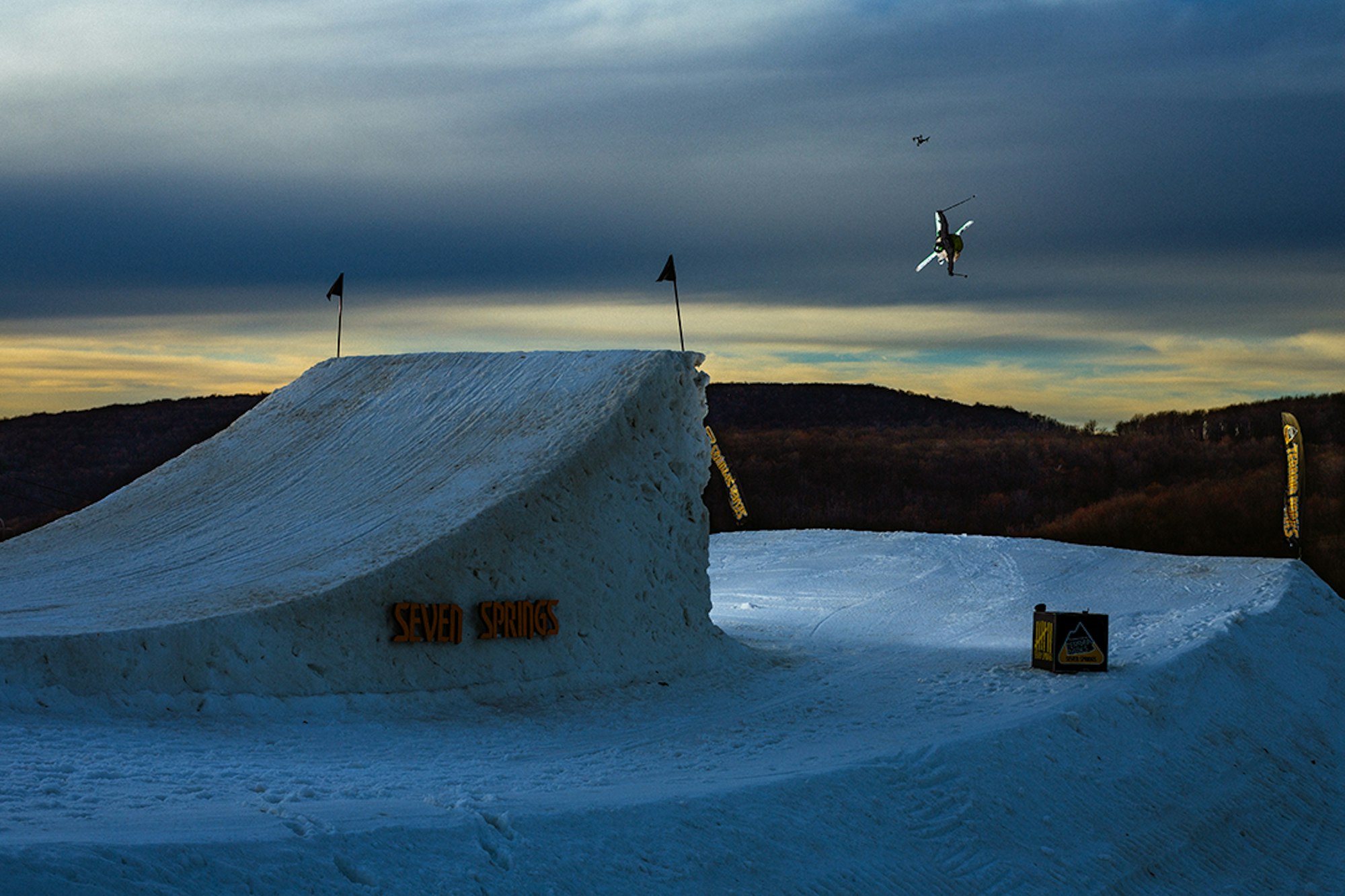
As the sun began to set, we all went back to work. Decker launched an RC helicopter, and the other filmers wandered through the russet grass on the sun-baked slope and found angles that did justice to the jump Seven Springs built, the skiers’ style and the warm light. And the athletes did whatever trick had the least impact on their bodies at the end of a long season. But they still asked what would look best for the camera and repeated certain tricks until they were happy with their grabs and body positions. There was no Latvian judge whose score would be dropped. Instead there were countless judges: The skiers themselves, the camera guys, the editors and, finally, the fans.
By virtue of winning FREESKIER’s Skier of the Year contest in 2010 and 2012, Tom has had his story told in this magazine. But if somehow you don’t know about Tom, here are the basics: He grew up in Pittsburgh, Pennsylvania, and learned to ski thanks to devoted parents who are, like their son, amazing in an unremarkable way. Enthusiastic without being obnoxious; supportive without micromanaging; hard working without being Type A.
Tom’s love of skiing and the nurturing of his family coalesced with his athletic talent, and in 2007, at just 19 years old, he won Level 1’s Superunknown contest and debuted on video to the masses in Realtime with a trick-by-trick redefinition of terrain park skiing. He was already known to the Internet ski audience, and as he showed remarkable consistency through contest results (X Games gold in 2010 and 2012, FIS World Championship gold in 2013 and an AFP year-end slopestyle title in 2012) and parts in major ski videos (from 4bi9, TGR, Field, Stept and the previously mentioned Level 1) Tom’s presence grew exponentially.
Heads up! You’ve arrived on page 2/2 of Tommy Be Good. To return to page one of the story, click here .
When freeski slopestyle was added to the Olympics as a medal sport for the 2014 Games in Sochi, Russia, it seemed inevitable that Tom would lead the strong American contingent in the discipline. And yet a major knee injury and the correlating downturn in results left him just barely off the team.
The opportunity to grow his mainstream recognition and solidify an iconic status in the sport seemed to be passing him by. Some people, faced with a similar disappointment, would have dropped off the map or maybe lost their way. Tom, however, has seemingly ignored the result to focus on skiing again.
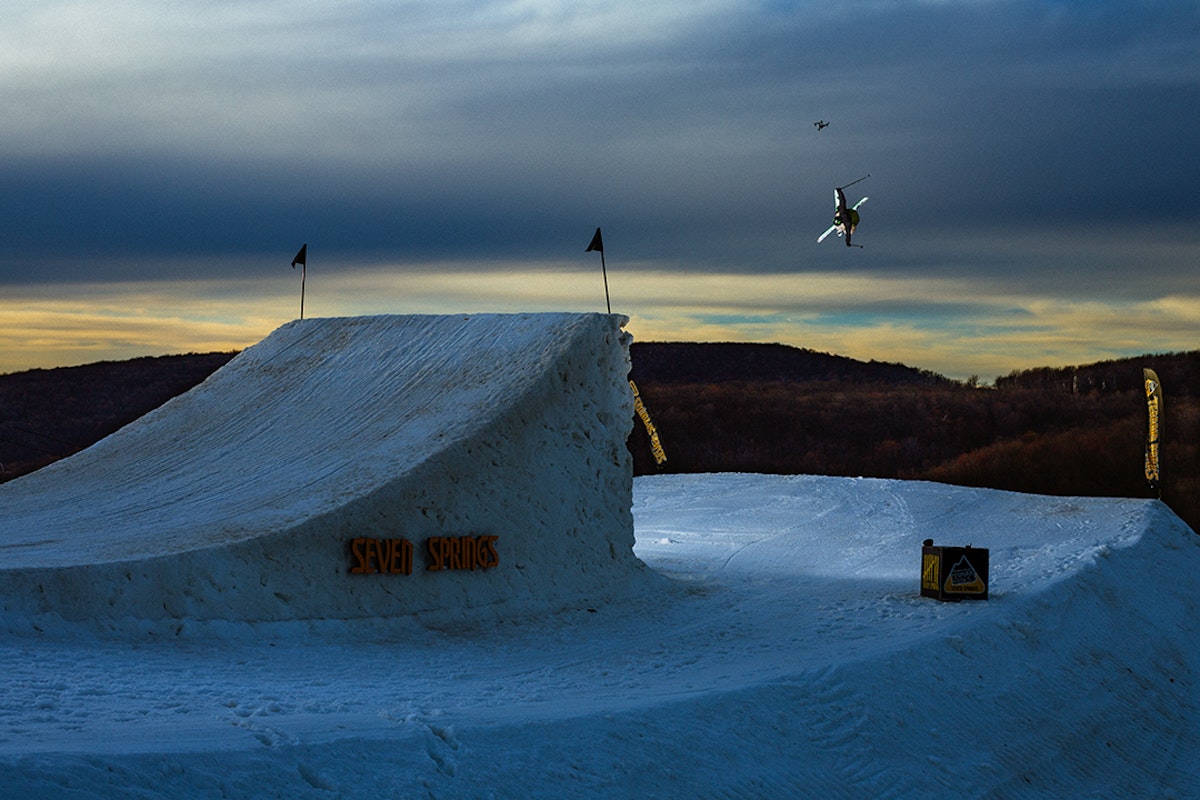
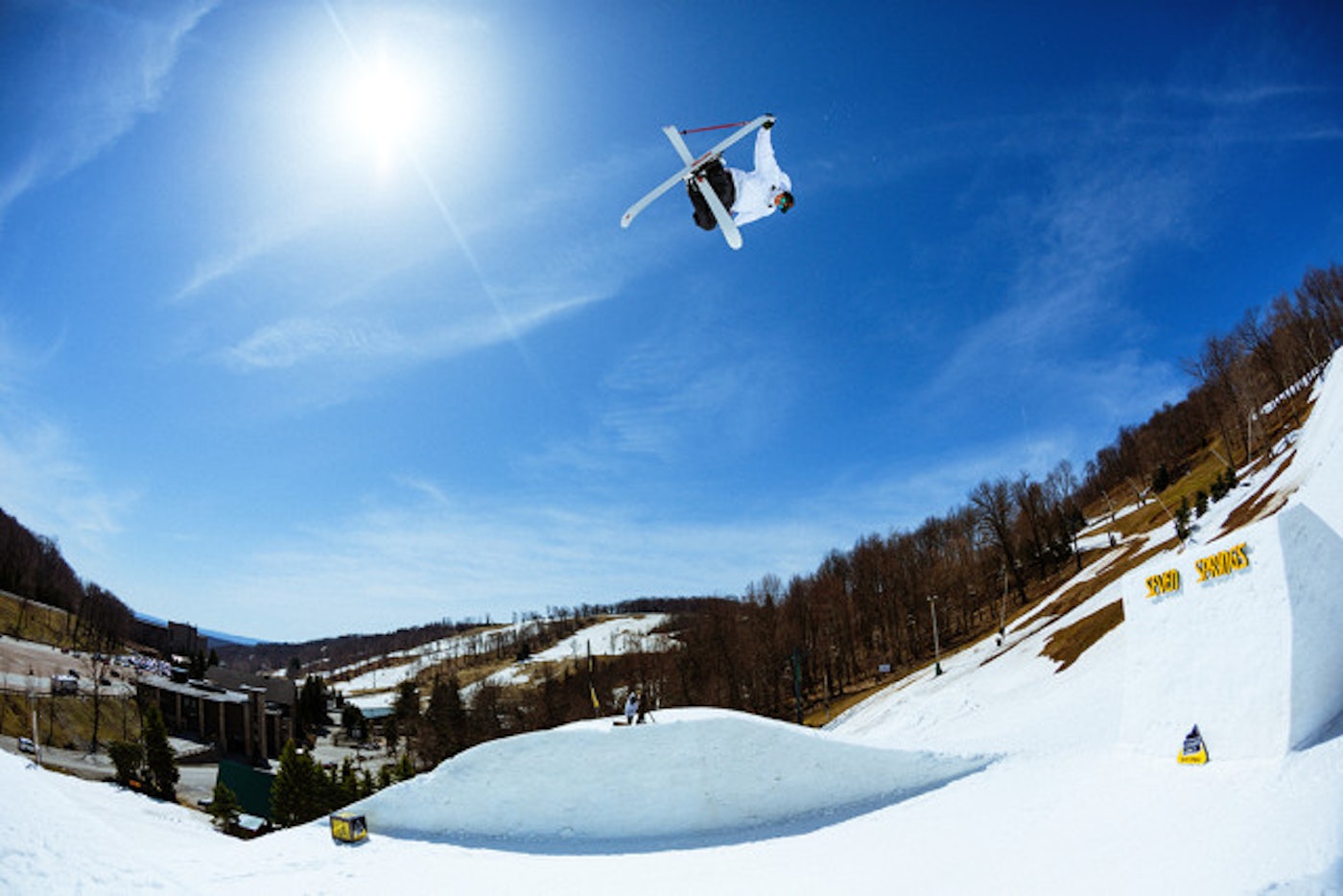
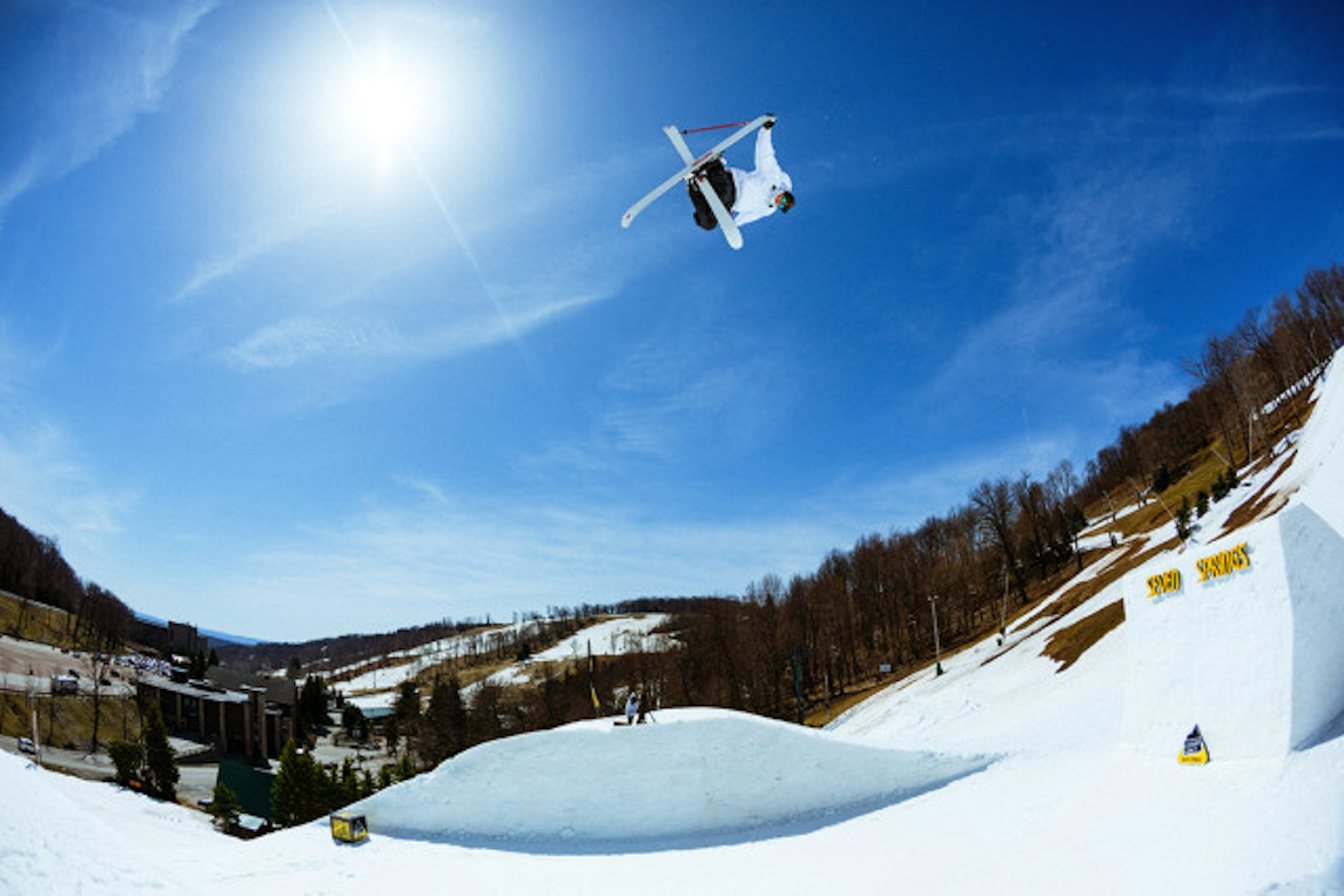
Much as the action in Tom’s episodes switches from spot to spot and genre to genre, the shoot at Seven Springs hit different parts of the mountain and a wide variety of features. As I first saw from the parking lot, there was a dual direction channel gap jump that they skied—left, right, both knuckles and even straight over the gap—in the middle of the day under bright sun and again the next morning at sunrise. They even went back, as the light faded under low clouds, on a third day when the tireless park staff had made a feature by placing a huge up rail on the rollover of one side of the landing. Slide up that at high speed, then gap to a tube before dealing with a severe drop to the landing, it was not mellow at all.
On the backside of the resort, all the remaining snow had been pushed into a table-top kicker. It was on this feature that Tim tried his triple, and on its hip that Karl Fostvedt bagged the closing shot of Two. The skiers also spent a few hours in Seven Springs’ Streets rail park. It is impossible to hold back talent, so the session that started as a mellow way to kill time while the park staff worked on other projects rapidly evolved into a slaughter fest of technical rail lines. Ware provided the epic finale when he slid the top of a wall ride perched over short transitions.
At each spot, skiers filtered in and out of the action and spectators gathered to scope the scene. Some were local fans, but they were also joined by some of the skiers’ and crew’s families. Much like the videos, the central figures went by the surname Wallisch, but the others joined in effortlessly to help. Mike Wallisch, Tom’s dad, pitched in with a shovel at the rail garden. I caught Mama Wallisch, Patty, cheering in the parking lot and firing up the troops after a break for lunch.
Patty and Mike’s lunch was a full picnic spread. All the fixin’s for enormous sandwiches and also side dishes, drinks and desserts, staged around their car. “I feel like we’re in middle school doing team sports,” I overheard Ware say as he fueled up for another jump session.
During the sunrise shoot, Yaps filled the back of an SUV with an assortment of McDonald’s breakfast items. And a special crockpot filled with pulled pork, provided by the Wallisch clan, was heated up for snacks or dinner on a couple of evenings. At each successive feature, you could count on finding snacks that ranged from a healthy mix of fresh veggies to chips and salsa. With a laugh, Kyle Decker told his mom that he was trying to work her homemade salsa into the films. That might not have happened, but it was delicious enough to make FREESKIER.
Taking care of the gang is clearly another key piece of the Good Company ethos. “One thing Wallisch did this year that I had a lot of respect for,” Decker told me, “is that he said ‘We’re going to sleep well, not be uncomfortable and eat halfway decent food.’” What’s the next step in ski trip cuisine? “Like Chili’s,” interjected Dakoulas after estimating, with pride, that he’d eaten McDonald’s only six times during the winter.
“Ten years ago, I could sleep in a corner and be as productive as I am today,” explained Decker about sleeping arrangements during urban trips, which are notorious for crowded rooms, little sleep and explosive tempers. “When you’re comfortably sleeping, you don’t get that burned out.” That’s not to say that there is any sense of entitlement emanating from Tom’s status as a genuine star—you won’t find craft services or warming tents on their shoots.
Wallisch’s co-producer Tom Yaps clearly believes in the philosophy. “He knows these guys are risking their limbs,” Decker said about Yaps. “He goes out of his way to make sure everyone is taken care of, and that’s how you run a proper operation.”
The way ski flicks are consumed has changed, and with The Wallisch Project and Good Company, Tom is refining this new way of producing and distributing content. The tradeoff with the immediacy and elasticity of access from social media and web-hosted videos is the erosion of the focused impact of hour-long DVDs and the season-opening movie premieres. To put it another way, do true fans exist in an age of six-second Vines, 15-second Instagram clips and two-minute YouTube videos? Part of the response to consumers with short attention spans is the tight editing of the films. Another piece is simply Tom himself.
Good Company has exhibited an abiding dedication to exceptional skiing that core fans appreciate and combined that with insistent pacing in the videos. Skiing is only the tip of the iceberg. Below the surface is the family philosophy and Tom’s unique personality—accessible and apparently effortless. Once the sport starts a dialogue between Tom and both nascent fans and devoted followers through edits, social media and even direct contact, new media also allows glimpses into the other side of life. That may be a short behind-the-scenes video or an Instagram that includes his girlfriend, Steph, or their dog, Derek the Dog.
Tom Wallisch’s 2015 street edit.
Many athletes with enormous sales power have become dislikable because they’re not actually good people or they market an untruthful public persona (Tiger, Lebron, Jeter, et al.). If Good Company can be considered a success in a marketing sense, it is that much more admirable because such a key factor in that triumph is how the Company is an extension of Tom’s earnest virtuousness.
One night during the shoot, everyone gathered for a big season-wrap dinner held in a roadhouse that sat just a few feet off a lonely, narrow road a few miles from Seven Springs. It was a genuinely homely place, and more fitting for this group than some fancy steakhouse.
As we sat around a long collection of tables in the center of the dining room, a middle-aged man screamed, “Skiers are in the house!” and pumped his fist in the air. Through the course of the evening many locals spoke with us: A pair of married skiers who told me about the history of snowmaking; a man in paint-splattered shorts and a Sherwin-Williams sweatshirt who explained that he could have been pro as either a snowboarder or skier, it didn’t seem to matter which; and our waitress who mentioned how good McChesney smelled enough times that it became a drinking game.
Countless wings of every variety, a few different pizzas, chips with guacamole and sour cream, bowls of pasta smothered in rich sauce, mozzarella sticks, juicy steaks and even some crab legs. It was all on the table. Halfway through dinner, between toasts, I watched as Tom reached over and demonstrated to Fostvedt how he should crack a crab leg and remove the meat. The shell wasn’t crisp, a little soggy—certainly not as good as you could find closer to the coast. It was easy to appreciate the sentiment. Here was Tom Wallisch showing a friend how to extract sustenance and enjoyment from something so simple.