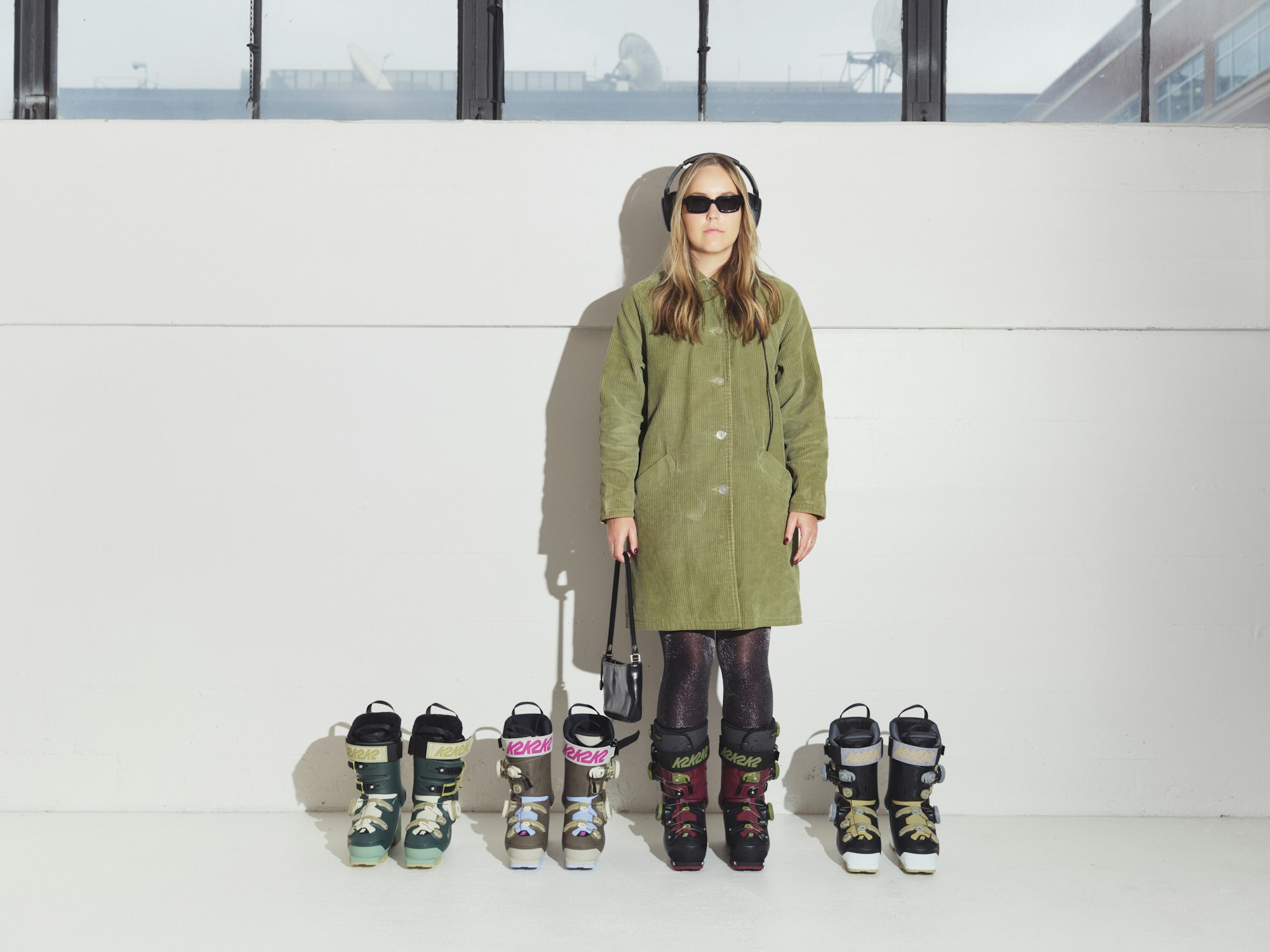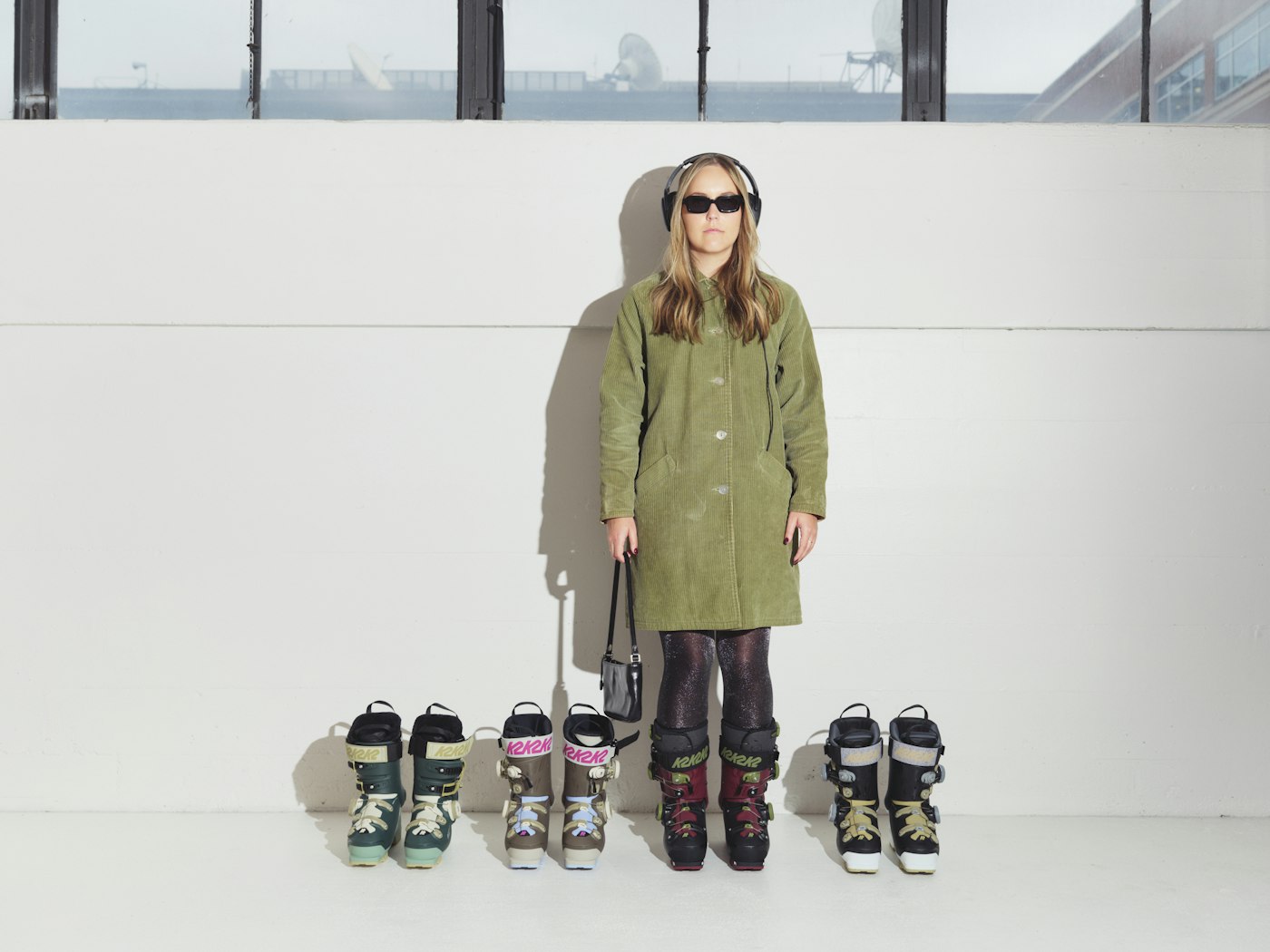
All Images: Courtesy of K2
For years, the case with women’s ski boots has been that they’re made from the ground up using a “unisex” mold. In other words, a boot originally designed with men’s anatomy and sizing in mind, later altered to “fit” and “look” like it’s made for women. But when a product isn’t originally designed around the person who’s going to use it, it’s never going to be the best possible fit. Unfortunately, that’s the case female skiers have had to deal with since time immemorial.
Enter Christie Burrow, K2’s lead engineer on the Anthem project. Hired in 2022, Burrow knew she wanted to help address this longstanding issue with women's ski boots. And that’s exactly what she did with the new redesign of the K2 Women’s Anthem collection , which launched this month and is now on the market.
“After seeing the same fit issues over and over again, it became clear that women deserved more than a modified version of an existing design," Burrow said in a recent press release. "With Anthem, we started from a blank page and built a boot around how women actually move, ski and fit into their equipment. Every decision, from shell shape to stance alignment, was made without compromise to deliver a more natural fit, greater comfort and increased confidence on snow."
But to understand why this is such a big shift for women’s ski boots, you have to look at how they’ve traditionally been designed and where the industry has fallen short.
Fit, Size and Flex
Historically, and still even today, ski boot engineers have made adjustments to these “unisex” models to make them more “women specific” in terms of anatomy and biomechanics. These adjustments often include lowering the cuff, making softer flexes, adding extra material to narrow the heel pockets and also sometimes adding things like a calf adjustment and heel ramp. But these modifications are really just shortcuts that allow manufacturers to keep building upon a model that they’ve been using for decades, rather than actually making a model based on women’s anatomy and biomechanics.
“On a women’s boot, the cuff might be shorter or more flared, but it still begins with men’s tooling,” Burrow said in an interview with K2 published on its campaign blog. ”Some boot brands claim a narrower heel pocket, but this difference is created by adding additional foam to the liner rather than within the shell itself.”
As a result, women get ski boots that don't properly fit or move naturally with their body. However, anatomical fit is only part of the problem. Sizing and flex are two other major limitations women face in the ski boot market.
Most women’s ski boots on the market today range from a 22.5 to a 26.5. As someone who has worked in a ski shop, I ran into this issue all the time; having to give a woman who measured as a 21.5 a 22.5 boot because that was the only option I could offer her. And that feeling was never great, especially as a woman myself, knowing I was sending a female skier out in a boot that wasn’t the correct fit simply because the right size wasn’t available.
“Ski boots are typically developed in one size (men’s 26.5 or 27.5) and then scaled to create the other sizes during a process called 'grading,'" Burrow said in the interview. “Grading begins after the first size is near completion, making it difficult (if not impossible) for women to be involved in the evaluation of fit or function.”
Those same limitations in how boot sizes are developed also carry over into a boot's flex option for women. The ski industry has held onto this idea that women need softer-flexing boots, when actually, that’s not always the case. Just like men, women have different body types, strengths and skiing abilities, and the flex of your ski boot should match that. For most brands, a 24.5 is the smallest size that a female ski boot can go down to in a 130 flex. So, if a woman is in a 23.5 or 22.5, her options often max out at a 115 flex, leaving her with fewer choices based solely on her boot size.
These are the limitations K2 wanted to change with the new Anthem collection. Not only does the lineup offer a true 21.5 size, but it also provides flex ratings ranging from 85 to 125 across all sizes. Buyers can also choose between Single BOA and Zonal BOA configurations. In other words, skiers aren’t limited by their boot size, weight or ability when it comes to finding the right fit and flex.

At The Core
This reinvention took over two years of development, 50 prototypes and 30 design iterations. But perhaps the most important part of the process was that women were actually involved in the conversations and testing. According to K2, one message remained clear: “women wanted equipment built around their performance needs, not adaptations of someone else’s design.”
To achieve this, Burrow and the K2 team developed three new technologies: TrueForm Last, TrueForm Cuff and True Align Geometry. Each plays a very important and unique role in accommodating a woman's anatomy and biomechanics, rather than a woman accommodating to the boot.
TrueForm Last
Many traditional women’s boots rely on thicker liners to create a more accommodating fit. But with TrueForm Last, the Anthem’s shell incorporates a women’s anatomical fit from the start by creating a shell shape with a secure heel and ankle pocket as well as a mid-volume fit and more accommodating toe box. According to K2, this helps to improve responsiveness and precision.
TrueForm Cuff
Building on that core foundation is TrueForm Cuff. This new technology completely redesigned the cuff profile to better match women’s calf anatomy. It does this by using a conical cuff shape that accommodates to the lower position and shape of the female calf, unlike a cuff designed around a straighter lower leg, which can create pressure points. The conical shape helps to distribute the shin pressure more evenly, not just create more room. The cuff also features an updated calf adjustment system.
True Align Geometry
According to K2’s press release, the True Align Geometry may be the collection's most transformative innovation. So, what is it? A female-specific stance system designed around the way women naturally balance and move on snow. The system incorporates a ramp angle, increased forward lean and repositioned cuff pivots. This helps skiers achieve a more centered, balanced stance while improving power transfer and edge control, according to the press release.


This collection doesn’t just mark a shift, but a new beginning for the progression of women's ski boot design. As a woman, I can only hope that this shift continues across the industry, giving female skiers even more options to ski comfortably with a properly fitting ski boot. We’ve already seen apparel brands like Wild Rye push the industry forward with inclusive ski clothing designed for a range of women’s body types. More recently, brands like RUMOR Skis , an entirely women-owned and designed ski brand, launched their debut all-mountain ski in lengths up to 183 cm, specifically addressing a gap in women’s ski offerings for taller skiers.
Now, I’m not saying K2 is the only brand working to progress women’s ski boots, but few have invested to the same extent as the Anthem redesign. K2 is leading the charge for women’s ski boots, and the engineering—and engineer—behind Anthem is there to prove it.