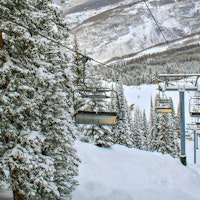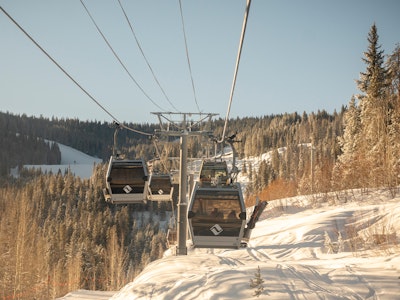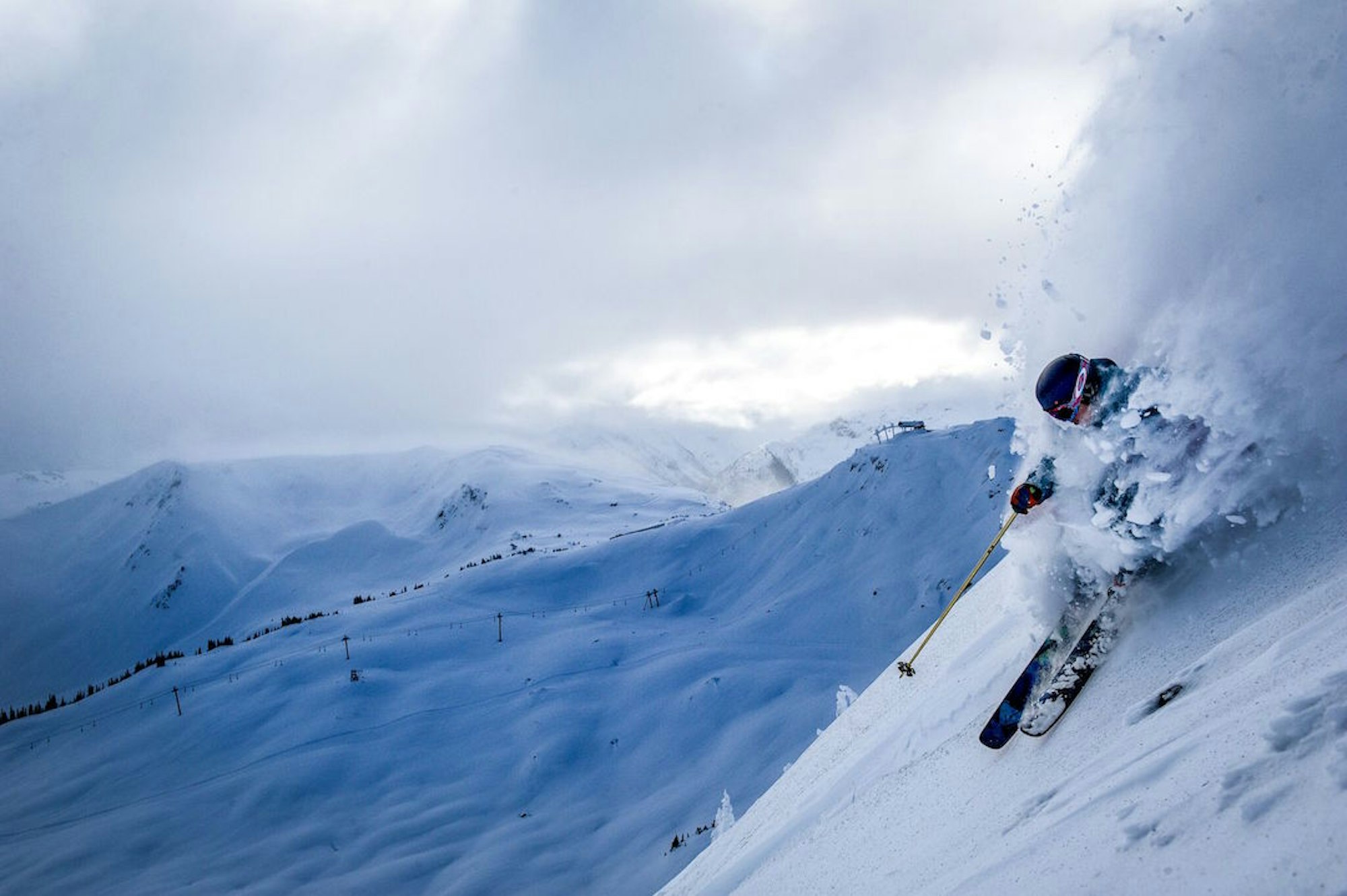
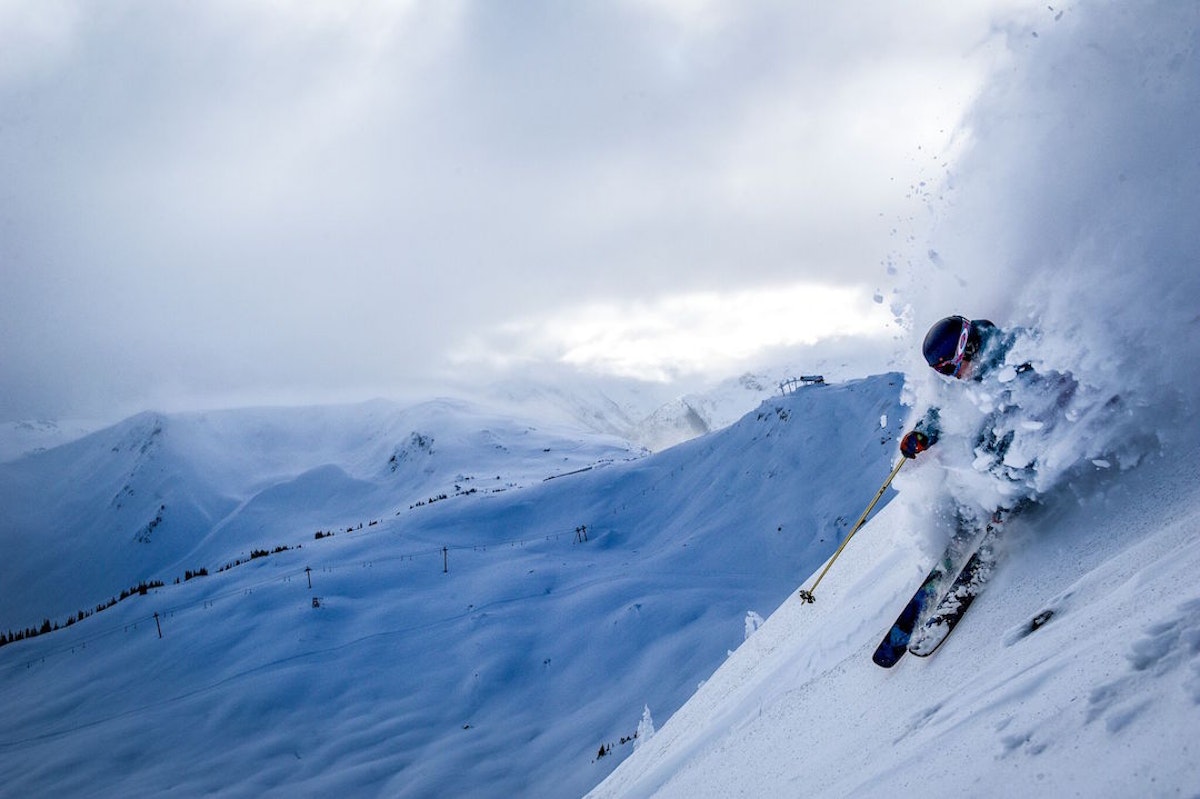

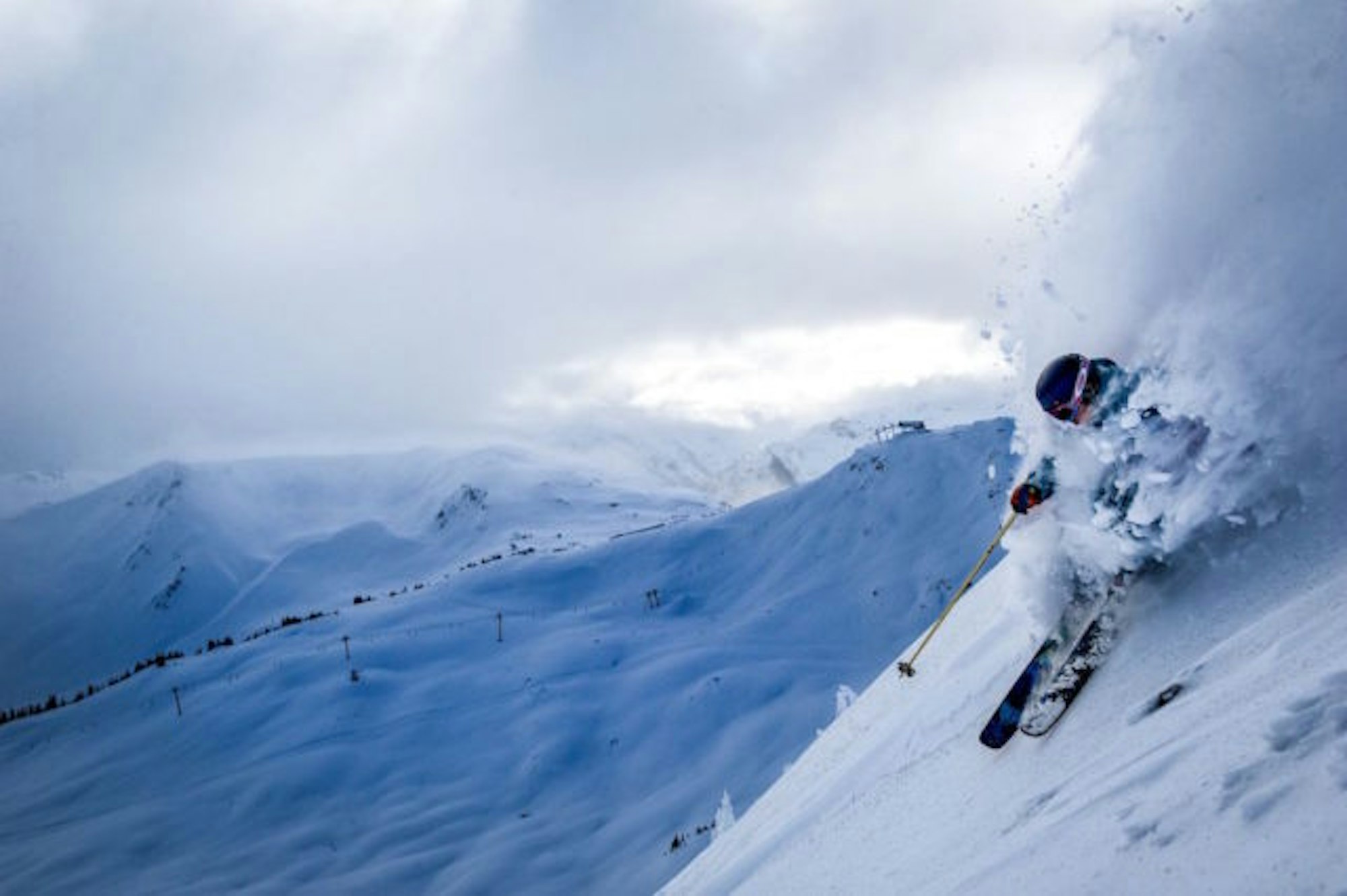
Symphony Chair, Whistler Mountain. Photo: Blake Jorgenson / Design: Gunter Jones
Note: This article appears in FREESKIER magazine Volume 19.2, the Resort Guide. Since the magazine’s debut, certain details of this story have changed, and been updated accordingly within this digital article. The original issue is available via iTunes Newsstand. Subscribe to FREESKIER magazine .
Howard Head forges metal edges; Doppelmayr unveils the high-speed chairlift at Breckenridge; Dean Coombs deploys helicopters in the Alaskan Chugach; Shane McConkey unleashes reverse sidecut, reverse camber skis… and the latest in skiing’s monumental moments: Vail Resorts buys Whistler Blackcomb. Imagine Ford buys Chevy. Steinbrenner buys the Red Sox. Coke buys Pepsi. Yes, Vail’s $1.1 billion purchase of only three-quarters of Whistler Blackcomb is that big of a deal, not just because of the historic rivalry or the fact that it’s one of the largest prices ever paid for a ski resort; the two most renowned entities in North American skiing have joined forces, creating what will soon become the world’s largest ski resort company.
“Huge. Extraordinary. This is the biggest deal ever. I can’t imagine one bigger,” said Hugh Smythe, a founding father of Whistler Blackcomb who guided the British Columbia resort through its 50-year trajectory toward becoming the largest, most trafficked, highest-grossing ski area in North America.
Smythe’s hyperbole reverberated across the skiing industry on that Monday in August when the deal was announced. Even hardened competitors of Vail Resorts (VR) acknowledged the bravado of the deal orchestrated by VR’s chief executive officer, Rob Katz.
Behind the hardly whispered catcalls of the growing empire and the threat of a corporate culture diluting Whistler’s electric, eclectic vibe, industry watchers grudgingly hailed the acquisition as Katz’s coup, a triumph that will elevate Vail Resorts and Whistler Blackcomb into an international powerhouse.
Most jaw dropping was the price. Considering that Japan’s Nippon Cable still owns a quarter of Whistler Blackcomb, VR’s stock-and-cash deal valued the 8,171-acre resort at more than $1.3 billion. And Katz, who has led his company’s ascension to resort ruler by adding nine resorts in three countries to VR’s stable in the past six years, paid top dollar. His price valued the resort at about 13.6 times Whistler Blackcomb’s annual earnings, being roughly $95 million for 2016—its best performance ever. Before Whistler, Katz was well-known for frugal purchases, like California’s Kirkwood for $18 million and Utah’s Park City for $182.5 million. He only paid more than eight times earnings—the common pricing strategy for ski resorts—once, with the Perisher acquisition in 2015. He almost doubled that with Whistler Blackcomb, setting a somewhat dubious price point for resort sales.
“This is a really incredible resort that has delivered amazing results and the terms of the transaction really reflect that,” said Katz, calling Whistler Blackcomb “one of the most iconic resorts in the world” and noting that his company has never stopped eyeing Whistler and “what could some day be possible.”
The deal harkens back to the late 1980s and early 1990s when Japanese investors paid huge dollars for resorts across the western United States—like Steamboat for $110 million in 1990, roughly $90 million more than its sales price a decade earlier. Those at-the-time staggering deals prodded the sudden growth of American Skiing Co., which imploded in the early 2000s, only a few years after borrowing way too much to fund deals like the $289 million purchase of Steamboat and Heavenly. American Skiing’s highly leveraged buys became a sort of industry benchmark for how not to buy big things, a lesson that has lingered for more than a decade. Until the Vail-Whistler marriage.
To pay that much, Katz is counting on a big payoff. But unlike Les Otten, the mastermind behind American Skiing’s spectacular collapse, Katz will likely notch the win. Whistler Blackcomb turns a pretty penny—Katz expects about $129 million a year—and it’s got the elusive connection with Pacific Northwest, Canadian and Asian skiers, opening several markets VR has long coveted.
The other winners could be Whistler skiers, whose $1,319 season passes will drop by about 40 percent when Vail Resorts’ $800-plus Epic Pass sweeps through British Columbia in 2017-18. (Not to mention, Epic Pass users get five days at Whistler Blackcomb this season.) If Colorado’s 15-year-old season pass war is a quality blueprint, other Pacific Northwest and British Columbia resorts soon will re-think season pass pricing strategies, aiming to keep pace with VR’s pennies-an-acre offering in the Epic.
Katz could pick up about 150,000 passholders with the addition of Whistler Blackcomb, pushing his Epic Pass sales close to 700,000, which likely eclipses the combined season pass purchases in the entirety of the U.S.
The whole new-boss-in-town thing can be disconcerting and Whistler locals expectedly decried the acquisition as an aggressive takeover if not a hostile invasion. But Whistler’s ownership history is hardly a tale of wine and roses.
Whistler was the flagship of Intrawest in the late 1990s and early 2000s, when the goliath ruled resortdom with real estate sales often surpassing revenue from skiing. Then, at the apex of the real estate bubble in 2006, when the company grossed $1.6 billion, New York hedge fund Fortress Investment Group paid a staggering $2.8 billion for the 10-mountain-strong Intrawest. About half of that was debt. Then everything went to sh#t.
As the economy stumbled and banks failed, Fortress was gasping under debt and Intrawest started jettisoning resorts. In 2012, Denver’s private equity firm KSL Capital Partners bought Intrawest’s 24-percent stake in Whistler, spending about $13 a share and leaving 24 percent with Nippon and the rest with undisclosed shareholders.
Since then, those shareholders have done well, reaping strong dividends that arguably pinched the resort’s ability to invest big in new projects. VR’s unsolicited offer—$36 CAD per share—close to tripled the IPO investment.
You’ve arrived on page 2/2 of The Growning Goliath. To start from the top, click here .
And without having to pay those big dividends, VR will have more to invest in Whistler Blackcomb’s capital improvements than any previous owner. Vail Resorts always pumps big dollars into its acquisitions, including $50 million last season to connect its Canyons and Park City ski areas, creating the largest ski area in the U.S. (but… still smaller than Whistler Blackcomb). Whistler Blackcomb CEO Dave Brownlie said Vail Resorts’ financial depth will enable the resort to pursue its ambitious Whistler Blackcomb Renaissance, a $268.5 million plan to develop year-round, weather-independent attractions like a water park, adventure course, action sports complex and luxury hotel.
“This is going to make Whistler Blackcomb that much stronger and our community stronger for the long-term,” Brownlie said.
Sure, it’s a tough pill to swallow, going from an independent entity to a jewel in a corporate crown. But the impact is lessened when that crown belongs to the biggest, richest, most successful ski company in the world, Smythe said.
“Even if there are concerns, I don’t think any of them are well founded. There’s going to be a period of transition where that level of trust needs to be built up, but … these are ski guys and they are very smart ski guys who run a really good show,” said Smythe, who was a ski patroller at Whistler in 1966, its first year of operation. “[VR has] a bevy of different resorts, each with their own identities. Not everything is Vail and Beaver Creek. Whistler Blackcomb has its own personality and culture and flavor and the two mountains are a mature resort. How much can you really change that? It is what it is. I don’t think Vail is going to change it all that much and any change there is, is going to be positive.”
Passholders certainly win. With his $809 Epic Pass soon to deliver unlimited access to almost 40,000 acres worldwide, Katz is providing skiing for about 2 cents an acre. That’s equivalent to early 1970s prices and a fraction of any other season pass deal out there.
That early millennium’s lament—ignited by Whistler’s former owner, the condo-fueled Intrawest—that skiing was becoming an amenity for luxury real estate sales? Katz has singlehandedly dismantled that, pushing Vail Resorts into a purely skiing operation. In fiscal 2015, 70 percent of his company’s $1.4 billion in revenue came from the mountain: passes, tickets, lessons, rentals, retail and food.
But the resort industry’s competitive landscape has forever tilted toward Vail Resorts. Make no mistake, skiing is now a monopoly. It’s next to impossible to thrive in a market where one company owns so much and offers it all for so little. Still, don’t expect the competition to wither. Watch them unite. A growing assembly of the best independent resorts is upping its game, even spinning the dominance of the gorilla in the room as a craft vs. corporate marketing ploy.
“There’s never been a better time to highlight the benefit of visiting an independent resort and really showcasing the differences,” said Christian Knapp, the former Vail Resorts executive who now heads marketing for Aspen Skiing Co. and spearheads the Mountain Collective, the swelling band of both large and small boutique resorts allied in battle with the Epic Pass.
Expect to see more multi-resort passes like the $419 Mountain Collective , which offers two days at fourteen of North America’s most coveted destinations, each an independently owned resort: Alta/ Snowbird, Aspen Snowmass, Jackson Hole, Sun Valley, Mammoth, Stowe, Ski Banff, Squaw Valley/Alpine Meadows, Taos, Whistler Blackcomb, and, most recently Revelstoke and Telluride. Vail Resorts plucked a trophy from that list, but for 2016-17 Whistler remains part of the Mountain Collective.
The $699 M.A.X Pass and its 39 member mountains has also emerged as a viable season pass player.
Those kinds of alliances boost the profiles of each resort involved.
“If you are looking for those passionate skiers and riders and the ability to market to them, this is a big step up over what an individual resort can do,” said Telluride chief and co-owner Bill Jensen, another former VR exec.
The VR deal for Whistler Blackcomb involved cash and stock. The company still has a lot of borrowing power, more than $68 million in cash and equivalents, as well as a swelling pile of company-owned stock priced around $160 a share. It’s not like the Whistler buy took them out of the acquisition game. If there’s another major, high-volume resort relatively close to a huge metro area that Vail Resorts wants to buy (cough, Mammoth? cough, Stratton?) the company is ready and able.