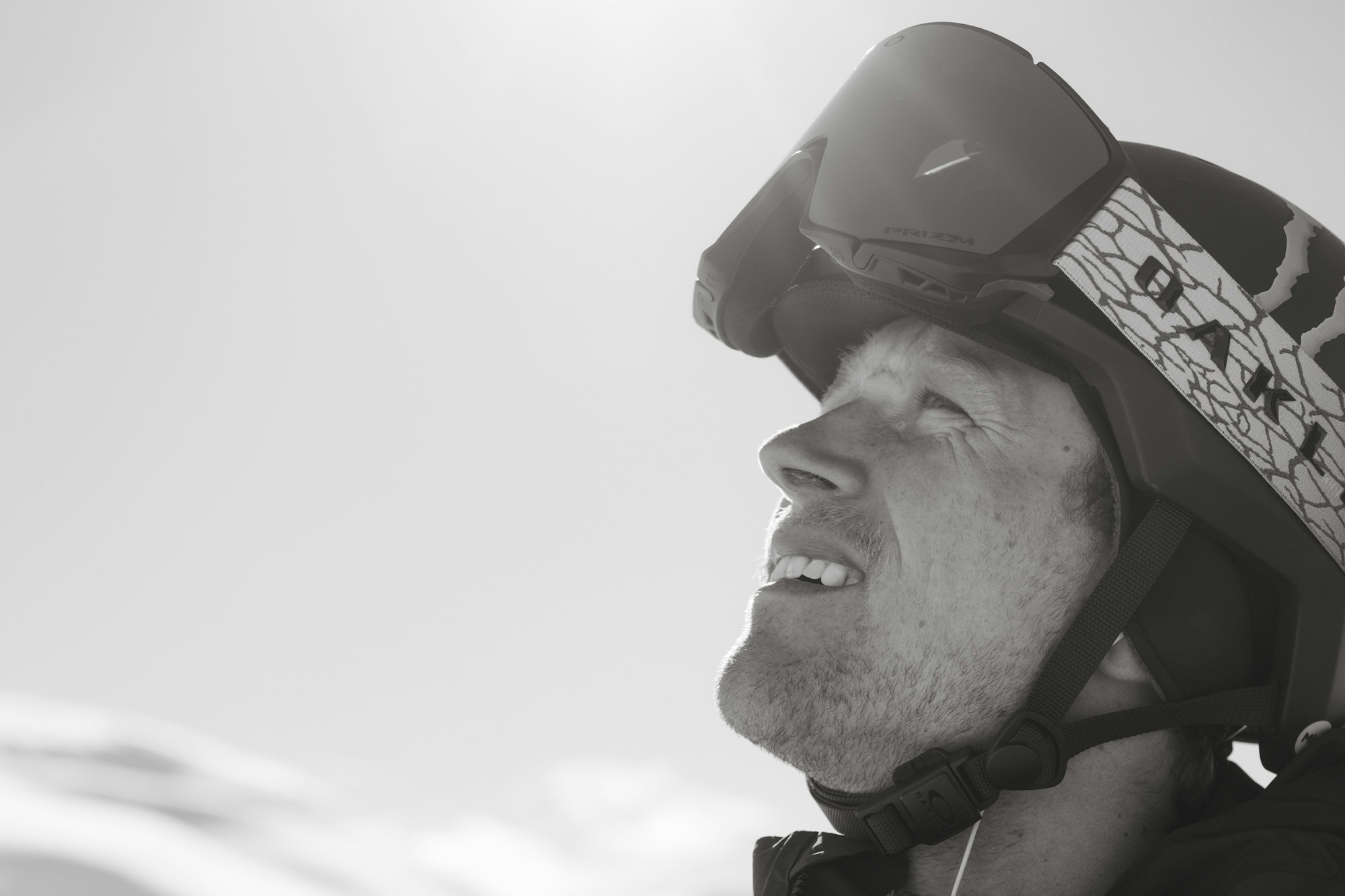
Featured Image: Chad Chomlack | Skier: Colby Stevenson
For several months in 2016, it was unlikely that Colby Stevenson would ever ski again. A car crash left him with over 30 fractures in his skull. The same mind and body that previously conquered 60-foot jumps and off-axis rotations with ease was reduced to fragments of its former self. Yet just eight months after entering the hospital that fateful spring night, he stood victorious atop his first-ever World Cup Slopestyle podium in Italy.
Since then, he's become one of the most dominant forces the sport has ever seen. And compared to the season of 2016/17, this winter was relatively smooth for the nine-time X Games medalist. But for most professional skiers, the winter Stevenson just had would have been the most turbulent of their careers.
Battling for a spot on the 2026 U.S. Freeski Team, Stevenson faced staggering competition as he tried to qualify for what could have been called the most talented team in freeskiing. Spoiler alert: he didn't make the cut. And while many would have let that fact consume them, Stevenson was already looking to the horizon. Through backcountry trips at home and abroad, he continued to hone his craft, dialing in new tricks and stacking clips for yet another stand-out project to be debuted this fall. And then it was off to Alaska for the second annual Natural Selection Ski, where he took first place among the most impressive freeriders on the planet.
After a year packed with ups and downs, FREESKIER sat down with Colby to gain insight into his motivational process. For a person who has already surpassed so many expectations and beaten the odds countless times, it would be natural to assume that a plateau was inevitable. But there's no sign of that. He's living proof that the power of perspective reigns supreme, as he repeatedly emphasized the importance he puts on looking at life through the right lens. It's clear that we can all learn something from one of freeskiing's greatest workhorses.
Thanks for talking, Colby. You had a rollercoaster season, to put it mildly. Coming up short on the World Cup circuit, winning two X Games medals, missing the Olympics, skiing three weeks of pow in Japan, winning Natural Selection Ski, filming throughout the season; it doesn’t get more volatile than that.
It was… character-building for sure. I couldn’t have predicted how it went down, but I’m proud of how I brought it all together in the end.
You were up against some talented skiers to earn a spot on the U.S. Slopestyle team. Walk me through your competition schedule and results heading into February.
The slopestyle circuit started in Stubai in November, but that comp got canceled with bad weather. So we were left with just two competitions to try and qualify [for the 2026 Winter Olympics]. Long story short, I finished ninth in Aspen and 11th at LAAX, which didn’t land me a spot on the U.S. Team roster. If I had to boil it down, I’d say I just kept coming off the rails early. It was unlike me, though I can’t say it’s the first time it’s happened in my career.
The World Cup stops didn’t go your way, but you skied great at X Games. Why do you think everything came together at that event specifically?
X Games is always my favorite event of the season. We get taken care of very well and get so many practice runs on the slopestyle course, leaving us to be the most prepared you can be for any event. It feels more collaborative than other competitions, too, especially with editions like Knuckle Huck and last year’s Streestyle. That one has so much potential if they built a larger set-up like War of Rails used to be. X Games if you’re listening, we need to bring that back. Put Tom Wallisch, Lucas Magoon, and Phil Casabon in charge and see what kind of big, street-like features they can come up with.
But to answer your question, looking back, I certainly felt less pressure [at X Games] since I knew it had no Olympic implications. So maybe that played a factor in why I skied well, but at the time my mind felt the same at X Games as it did at the World Cup stops. I was also vouching for the US Team to count [X Games] as an Olympic qualifier since Stubai was cancelled earlier in the year, but it was no use, as the criteria is written four years prior and cannot be changed.
Speaking of, do you think knowing that you had a shot at another Olympic medal caused you to change your approach to competitions in general?
If I changed my approach, it wasn’t on purpose. I take every event the same way. I go into it with an open mind and try to build my favorite run, and usually that’s something creative, different, and challenging yet feasible. I’m always changing components up. It’s like putting together a puzzle, only there’s no right answer, and that’s what I love about it. You can’t conform to what you think might win; you’ve got to trust yourself to do what inspires you.


Stevenson secured silver in both Slopestyle and Knuckle Huck at X Games Aspen 2026
Photo: Matt Power
Having been to the Olympics in 2022 and won silver in big air, did you feel less pressure to make it a second time around, or was the drive just as strong?
I mean, I’m a competitor, so I certainly wanted [to make the Olympics] just as much as I did in 2022. While I’ve become more entrenched in backcountry riding the last few years, I still love slopestyle and I put everything into it when the time comes. Sometimes it just doesn’t go your way in competitions, and that’s just part of it. I’ve felt the draw of living through hindsight so many times, but it’s no way to carry on. You have to learn from your experience and understand that if you trusted your gut and tried your best, there’s nothing else you could have done.
Did you have that same mindset immediately following the U.S. Team announcement?
Yes. I knew I’d done my best given the circumstances, but that doesn’t mean it still wasn’t devastating. My family had already booked flights to Italy and letting them down was easily the hardest part. So I gave myself the grace to soak in that feeling, that disappointment, but after a couple of days I knew the best thing I could do for them and for myself was to keep going; keep skiing. Like anything in life, you can’t control the outcome of some situations, but you can control how you respond to it.
I admired the fact that you didn’t pick up the phone and put out a big message about missing The Games. In fact, I think the first thing I saw you post after the U.S. lineup debut was just a clip of you skiing an avy barrier in Japan.
Yeah, the temptation to scream to the world in a situation like that is always real. It just didn’t feel right for me in that instance; that’s not what I’m here for. Skiing is my life, but it’s an evolving journey, and I want to show that there’s much more to life than one event, even if that one event is the Olympics.
I mean this with all respect to The Games, but speaking from experience, I can say that while winning an Olympic medal is amazing, it’s not going to alter your life as much as you might think. You still have to get up in the morning and work on whatever’s coming down the pipeline next. It won’t mold you into a good person, or give you satisfaction for the rest of your days. I think goals like that are super important, but you can’t let them completely run your life.
You’re clearly a big believer in the power of perspective. Did that stem from your car crash, or was it instilled before that?
I’d credit it to the accident, no doubt. For anyone who doesn’t know, I was in a car crash in 2016, fracturing my skull in 30 places. Broke my neck, had a traumatic brain injury… I thought I’d lost skiing for good. Before that, I’d had several injuries that increasingly left me more timid in my skiing, but this was so different.
At first, skiing wasn’t even in the conversation. Life was just about becoming a normal human being again. But while I was still recovering in the hospital, one of the doctors showed me a scan of all the hardware they’d put inside my head, and I swear the titanium bolts looked like snowflakes. Once the doctor pointed that out and mentioned that my skull would be more durable than it was before, it flipped a switch. I started thinking, “No way, maybe this was meant to be.”
That was the start of a new era. I began to realize that it’s truly not about what the world does to you, but rather what you want to do with the world. I started thinking about perspective in every area of my life, and to say it helped is an understatement. It changed everything. Eight months after my accident, I won my first competition back at a World Cup event in Italy.
Editor's Note: If you're unfamiliar with Colby's past, I highly recomend watching " NERVE " - a biopic detailing his car crash, injury and subsequent recovery. Inspiring doesn't even begin to cover it.
Is it fair to say you follow the philosophy of “everything is meant to be” in life?
Yes and no. I believe that everything happens for a reason and the path of your life will always look different than what you imagined. Your life is ultimately a result of your thoughts, dreams, aspirations, and the day-to-day actions you take towards them. Combine manifestation with persistence and a bit of delusional optimism, and you have the formula for what it takes to achieve greatness in anything you want. Perspective is everything after that. I think it’s just about taking whatever that experience might be and learning from it. If you’re a skier and you get hurt, use it as a reason to slow down and focus on another area of life. Find a positive from every bad situation; it might take awhile but there always is one.
You can go the other way and dwell on the past if you want, sitting around acting like Captain Hindsight, but I’ve been there, and it’s a terrible way to live. [ Laughs ] Take it from the guy who smashed his head; it’s better to let things be water under the bridge, and to keep moving forward with what you have.
So when you missed the Olympics, who was the first person you chatted with to keep moving forward, as you put it?
I’d talked with Finn Bilous a few weeks before [Olympic] qualifiers were announced. He’s a good friend, and he kept saying that if I make the team, great. If not, I should come meet him in Japan. The rest is history.
And Japan provided?
It was incredible. There was no better place I could have gone to get my mind right. My first time in Japan was two years ago, filming with K2 for “ Rikka .” It was an eye-opening trip, and although we didn’t get to explore a ton, the sidecountry we skied left me hungry for more, so I was pumped to return.
I don’t think it stopped snowing for the three weeks I was in Hokkaido. I skied with Finn a bit, and Hunter Henderson came out to ski too. I spent a few days on my own, as well. I hired a local filmer, Kazuma Takeshita, and we stacked some great footage. Boot packing through waist-deep snow was exhausting, especially for a guy like me who’s lucky enough to spend so much backcountry time on Ski-Doo’s. Lapping avalanche barriers and kickers over there takes another level of determination, but it was worth every step.


Earning clips in Japan, one boot pack and pow turn at a time
Photo: Taylen Louise
Your last two video projects, “PHANTOM” and “PROOF,” were fantastic. Is your drive to film growing every season?
For sure. At this point, I almost view competition skiing as a way to stoke out my sponsors so I can afford to go film backcountry parts. I was really happy with both those movies, and I learn something new with each one we put out. This year’s footage shaped up well, too, because after Japan I met back up with Jack Francis in Utah and we got my only jump clips of the season. I won’t spoil what the tricks are, but I’m very proud to have put them down. Add to that our footage from Alaska, and I think people are going to like what we’re cooking up for this year's film, “PROVIDE.”
Watch “ PHANTOM ” (2025) and “ PROOF ” (2024)
Alaska must have been quite a grind between winning Natural Selection and trying to stack footage. How was the NST experience compared to last year?
I’ll start by saying NST has become my favorite competition in skiing. We’re all friends, everybody really wants to win, and we are collaborating on skiing some pretty gnarly terrain, so it creates an awesome atmosphere. The event staff is also on another level. They dealt with so much this winter, and the fact that we even had a competition at all is a testament to their drive.
Being a part of the first NST Ski last winter was unbelievable, but I’d say we were all pretty scared. The conditions weren’t great, and the face we rode was massive. I was also far less confident in my freeride skiing as I barely rode pow all season. Whereas this year, because I got to spend so much time both at competitions and in the backcountry, I felt far more dialed.
It’s no secret that the course this year wasn’t the originally intended option. Did that throw you for a loop when they switched it up?
Well, the original face this year was a legendary zone called Spine Cell. It’s steep, loaded with features and, obviously, plenty of big spines. They let us know that was the target three days before we got there… so we were all on edge, but honestly I was ready for the challenge. I was slated to drop first, so I was ready to just go for broke and send it [ laughs ].
There was a lot of talk about a persistent weak layer permeating the whole area, but we knew the guides wouldn’t run the event if it was too dangerous. When we were scouting, I kept noticing a lot of exposed rocks, way more than what I’d seen in past photos and clips. Sam [Kuch] and Craig [Murray] were pretty juiced on the whole operation, but those guys are on another level. They’ve spent so much time in those mountains and have such familiarity with exposed terrain. I’d say the rest of us were more hesitant.
But it didn’t matter in the end, because the warm-up face [on Spine Cell] slid just before and we had to hunt down another zone. Markus [Eder] and Travis Rice went out and found what became our final option. It wasn’t ideal, but given the circumstances, everyone was excited regardless. It was that or nothing, and we all wanted to give it our best. The whole NST crew put in so much work to make this happen, too, and I hope people understand what it took to make it happen.
As the most notable slopestyle skier in the competition, did the new course boost your confidence?
Yes, but I knew it wouldn’t be an easy path to victory. Everyone in our field is so versatile and experienced. Karl, Sam, Tanner, Markus, Craig, Jonah, Finn - nobody was out of contention. I knew that I had a few tricks in the bag that would give me a solid chance at winning, but even with a course that catered to my style, NST is about more than just tricks. You need style, fluidity, creativity; you can’t just go huge and accept to win. That’s what makes the competition so unique.
But in the end, you pulled out the win. What was your favorite trick you stomped that day?
Dub 10 blunt, easily. That’s been my favorite trick for 10 years. I landed it in the backcountry for my film “PROOF” a couple years ago. It took so many tries.


If you haven't watched Stevenson's winning run from NST Ski 2026, now is a good time to do so
Photo: Leslie Hittmeier, Chad Chomlack
Looking back at the year, do you think balancing filming and competing at the level you do is sustainable, and is it a labor you plan to continue?
I feel like Alex [Hall] and I get this question a lot, and we usually say the same thing, which is that while the balance is a lot of work, the two complement each other so well. It makes it all worth it. Starting the season off with competitions and the discipline that life requires sets you up for success later in the winter when you head into the backcountry, because you can take what you’ve learned and that same work ethic and apply it elsewhere with a bit more artistic liberty. A nose butter dub 16 in the wind on icy jumps makes a backcountry session feel blissful. So while it’s a lot of work, I totally plan on staying at the forefront of both. It is quite taxing on the body, I must say. If it’s snowing, the only real off days I have are travel days.
Competitions have a very rigid definition of success, but how do you personally define a positive outcome when dealing with making a film?
That’s a good question. I’ve always made my projects for dedicated skiers, and I really value the opinion of those who have poured so much into this sport. At the same time, I hope that someone who knows nothing about skiing can look at what we make and appreciate the work and the artistry that goes into the entire process. From scouting the location to stomping the trick to the camera work and everything in between, I want it to inspire people to pursue what’s meaningful to them.
I’m a big believer that by doing what we truly love with authenticity, the outcome will always be beautiful. My friends and I, we’ve worked our whole lives to build this skillset. We’re on this earth to enjoy our own journey, and I want everyone to go at life with that view, working on whatever craft calls to them. If the film reflects that, then it’s a success.
Well said. On that note, take us out with one filmer and one skier you look to for inspiration when putting together a video part.
It’s hard to pick just one. Tanner Hall was always my biggest inspiration with his old segments and movies. Sammy C always has dope projects with raw style, and Henrik Harlaut has blown my mind many times taking tricks to the backcountry.
These days I just have fun watching my friends create things. Finn Bilous has a very creative project coming out this fall, and I love how he blends every part of his personality into his work. For a filmer, I have to say my guy Jack Francis . He and I started out as good friends, students of the mountains, snowmobile homies. He picked up a camera and came to it so naturally. He inspires me and constantly reminds me why we do this shit; Simply for the love of it. Every day we get to be in the mountains is a blessing.
Colby's limited-edition ski, the K2 Omen Colby Stevenson , is available now on the K2 site. "The crushed skull graphic tells that story: breaking down, rising up, and turning struggle into superpower." Grab a pair before they're gone!