Featured Image : Courtesy of University of Washington Libraries/Unsplash.com
In the world we live in today, which is constantly changing and adapting to new technological advancements, it can be easy to overlook the history that shaped the present. Yet understanding the past helps explain why things are the way they are today. Even in skiing.
In a fast-paced sport like skiing, it can also be easy to overlook the history beneath the ski lifts you ride on every season. But skiing wasn’t always as accessible as it is now, in fact, riding a ski lift was just as dangerous back then as dropping into a chute and just getting to ski resorts was even scarier than driving next to semi's on I-70.
Besides all of that, humans were still able to create an industry that is now loved by millions. But some ski resorts' history can get repetitive, so below, I tried to compile a list of 5 ski resorts with unique history beneath their lifts.
1. Sun Valley Ski Resort, Idaho
Union Pacific Railroad Chairman Averell Harriman created Sun Valley Resort in an attempt to boost passenger traffic during the Great Depression. Ironically, now skiing is one of the most expensive sports in the world, but hey, it obviously worked. Sun Valley is North America’s first destination ski resort, opening in 1936, so it feels fitting to start with this resort.
During the Great Depression, many of these mining towns became ghost towns, and investors sent out mountaineers to explore these areas and invest in resorts to try to get people out West. Consequently, Harriman wanted to bring the chic European resort culture to America, so he sent out Austrian Count Felix Schaffgotsch to find the perfect location, according to Sun Valley's website . He discovered Ketchum, Idaho, while exploring the area, which is now home to Sun Valley Ski Resort.
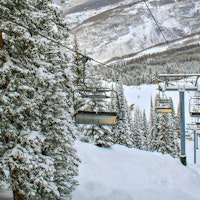
Only a year before opening, Union Pacific engineer Jim Curran created the world’s first chairlift for Sun Valley Resort. The lift was based on a design that was originally used as a conveyor system to load fruit onto ships, according to Sun Valley's website . This design, which revolutionized the ski industry, is now used by thousands of skiers each year to get around the mountains. Of course, there have been many advancements to the modern-day ski lift, but still, that’s bananas that it was based on a system for transporting fruit; no pun intended. Remnants of the chairlift are still visible on Proctor Mountain today, where it was originally built.
2. Howelsen Hill, Colorado
Since the establishment of Steamboat Resort, it is easy to miss the fact that Steamboat is actually home to another ski resort that is the oldest continuously operating ski facility in North America: Howelsen Hill . But this ski resort isn’t just for the everyday skier; it has produced hundreds of Olympic athletes and is home to the largest and most complete natural ski jumping complex in North America. How did this small ski hill in Steamboat, Colorado, become home to this? Well, it all started with a Norwegian immigrant who joined the circus.
Karl Frithjov Hovelsen, also known as Carl Howelsen, immigrated to America in 1905. Before coming to America, he grew up winning Nordic cross-country medals in his home country. How did a guy who joined the circus create an Olympic-class ski jump center? Well, after immigrating to America, he joined Barnum and Bailey’s, where he took his ski tricks to the circus. Coined as the “Flying Norseman,” Howelsen became a crowd favorite, commanding a wage of $200 per week, which at the time was a very large wage, according to the Steamboat Chamber website . He would attempt insane tricks, like ski-jumping over obstacles such as elephants.
After traveling with the circus for years, he moved to Denver and later to Steamboat in 1913. He quickly established himself as Steamboat’s resident authority on all things snowsports. It was through this that he helped orchestrate the steamboat's first-ever Winter Carnival, which included all things winter-sports-related, and it is still held annually. After its success, Howelsen wanted to make an even bigger ski jump for the event, but he just had to find the right location. That is how Howelsen Hill was founded. The mountain is located in central Steamboat and attracts ski jumpers from around the world and it is now a consistent home base for the U.S. Ski Team and the Steamboat Springs Winter Sports Club.
3. Pajarito Mountain, New Mexico
While creating the world’s first nuclear bomb, I can imagine that one needs an outlet outside of the laboratory, and that is exactly what Los Alamos Scientists did with the creation of Pajarito Mountain . In 1943, a group of Los Alamos scientists and soldiers came together to create a ski area, becoming the Los Alamos Ski Club, according to Pajarito Mountain's website .
The group originally began skiing at Sawyers Hill, where they would pay a $7.50-per-person membership fee for a single tow rope. But the snow there was unreliable, and eventually the group discovered Pajarito Mountain. In November 1957, the resort opened with two tows, double the vertical drop of Sawyers Hill, a beginner's slope, and a narrow trail from the upper tow rope, according to Pajarito website . Improvements continued, and the Los Alamos Ski Club poured into the resort, eventually adding T-bars, chairlifts, and a lodge. The mountain is still running today and is still independently owned.
4. Cooper Ski Area, Colorado
Even today, Ski Cooper, located in Leadville, Colorado, is known for its vert and high-altitude, and during World War II, the U.S. Army used this to its advantage. Around the same time as the Los Alamos project, the 10th Mountain Division trained at what is now known as Ski Cooper. The 10th Mountain Division was a specialized combat unit that required mountaineering and skiing expertise and eventually fought in the high mountains of northern Italy during World War II. The soldiers were trained at what they called, at the time, Cooper Hill, in Leadville, Colorado, where the altitude is high, and the mountains have more rugged terrain.
At the time dubbed Cooper Hill, this ski area sits at 11,700 feet and is known for its consistent snowpack, making it a great option for replicating conditions in the Alps. From 1942 to 1944, troops trained on Ski Cooper's steep terrain with heavy backpacks and rifles on their backs, learning how to survive in mountainous conditions, according to The National WWII Museum in New Orleans . At the end of 1944, the men were deployed to Italy with a mission to help capture the heavily fortified Mount Belvedere. Successfully taking over would allow the Allies to break through the German Gothic Line (a German and Italian defensive line) across the Italian peninsula, including the Apennine Mountains. The mission was successful but also cost the division hundreds of casualties and wounded soldiers, according to The National WWII Museum, New Orleans .
Now Cooper Ski Area is known for having extreme vert, which only locals or advanced skiers go to ski in Colorado. Camp Hale, the base where soldiers stayed near Ski Cooper, is now a National Monument honoring the brave soldiers of the 10th Mountain Division.
5. Snowbird Resort, Utah
While yes, the history of Snowbird is like many other ski resorts' origin stories, they have found a way to incorporate their history quite literally into the mountain. As a history nerd, the first time I rode through Snowbird's Peruvian tunnel, I was obsessed because the attraction combined my love for skiing and history into one. The tunnel is a magic carpet that takes skiers through a 595-foot museum tunnel, transporting you into what feels like a whole other world (connecting the front side to the backside’s Mineral Basin bowl).
Many of the same traverses at Snowbird that skiers now use were once busy with mining carts, as the area was part of the silver boom. Silver was discovered in the mid-1800s in Utah, and from there the industry boomed. Alta, Snowbirds' neighbor, became a mining town and was home to about 5,000 to 8,000 people, according to Alta’s website . But by the 1920s, the Great Depression hit, which affected many of the mining towns out west, and is why so many resorts exist today, as those towns became ghost towns. By 1938, a group of local businessmen took over the area and raised enough money to build Collins lift using remnants of old mine trolleys and salvaged timber, according to Alta’s website . It was then that Alta Ski Area was founded.
Ted Johnson, the founder of Snowbird, originally came to Alta in 1954 to work at Rustler Lodge, according to Snowbird's website . While he was there, he began to realize his dream of opening a ski resort. From 1965-67, he and his wife began secretly buying old mining claims because they didn’t want others to hear about their plan, which would drive up the claims' prices, according to Snowbird's website . He partnered with wealthy investors of the time, such as Dick Bass, and eventually opened the resort in 1971.
To show the history I just summarized above, the tunnel showcases 150 years of it by creating a mini museum around the magic carpet ride that runs beneath Peruvian Ridge. The artifacts include old mining carts, tools, carriages, and photographs from the area's mining boom. At ski resorts, it can be hard to realize how much history you are skiing over, and this resort has found a way to incorporate that history into the mountain.