
Hook, Line and Send ‘Er!
Josh Bibby’s text message read, “I’m bringing my new throwing axe, three throwing knives, two hatchets, my fishing gear and a few fireworks. We can pick up more—there are lots of stores that sell fireworks on the way.” I replied with my list of fishing gear, shotguns, ammunition and various shooting targets. It seemed we were well equipped for the upcoming two-week-long adventure.
Leaving behind the zoo that is Whistler, BC’s, springtime pro ski and snowboard filming scene, we pointed ’er north towards quieter towns and bumpy logging roads. Our goal: use the rivers that run between Smithers, Terrace and Stewart, BC, as well as Hyder, AK, as our road map into the mountains. Bound for an area that is world renowned for both its backcountry skiing and its freshwater fishing, we had high hopes from peak to creek.
Given our agenda included exploring, skiing and fishing, we couldn’t have had a better crew. Despite Bibby, TJ Schiller and I having been longtime friends, we rarely end up on ski trips together. This outing was nearly 10 years in the making, and we were determined to make it one to remember. So, with enough weaponry and explosives to fend off a small army, and sleds loaded on the Armada- branded one-ton F-350 as well as Schiller’s truck and trailer, we were off to the Skeena River Valley with plans to grab photographer Bryn Hughes and cinematographer Jamie Tanner along the way.
We’d heard nothing but amazing things about the mountains that surround the towns of Terrace, Stewart and Hyder. As we made our way towards the northern coast, the mountains grew larger and more dramatic in profile—this was big country.
The peaks measure approximately 6,000 feet from summit to valley floor, where they collide with famed sport-fishing rivers such as the Skeena, Kalum, Bulkley and Kitimat. In these quaint, northern locales, a combination of AStar helicopters and high-powered riverboats are the preferred travel methods of outdoor enthusiasts. In order for us to reach the best spots—both in the mountains and on the rivers—it quickly became apparent that some impressive recreational tools would be required. With limited knowledge of the area, we turned to the Backroad Mapbooks, Google Earth and a few locals in order to scope potential access roads.
Our first stop on the journey was the Skeena Cat Skiing lodge in New Hazelton, 133 kilometers (82 miles) northeast of Terrace, perched on the Bulkley River. As we pulled up to the lodge, we encountered a cat skiing group; they were still in ski boots and enjoying some beers around a couple of bush-run Chevy Silverados while they reminisced about the day. We instantly felt at home. The family-run outfit was full of character and void of unnecessary luxuries that are often part of larger or more corporate cat skiing ops.
[juicebox gallery_id=”182″]
The next day, we followed owner and longtime guide, Jevon Zyp, on the 30-minute drive to the trailhead. Knowing the road like the back of his hand, he navigated with ease. The going was a bit tougher for our truck, thanks to the sled deck and double trailer in tow. The same could be said for Schiller’s truck, as it suffered from broken four-wheel drive. We narrowly avoided sliding off the road on a downhill, icy, off-camber corner before we arrived—adrenaline on high. Playing it off as ‘no big deal,’ my white knuckles moved from the steering wheel to handle bars, and we made our way into the hills.
“Bound for an area that is world renowned for both its backcountry skiing and its freshwater fishing, we had high hopes from peak to creek.”
After a couple of hectic days on the road, nothing felt better than some powder hounding. Inclement weather left the alpine out of reach for the day, but deep snow in the trees provided an ideal alternative. We had fast laps and plenty of them. Our snow-filled beards and unwavering smiles made me think of the cat skiing group from the day prior. I now knew what they had been reminiscing about.
Next, we followed the Skeena River west into Terrace, checked in at the Bear Country Inn and mapped out our upcoming week. After bullshitting with some of the locals at a sled shop and cross referencing with Google Earth, we followed the Kitimat River south to a promising sled zone. At the end of a very muddy, active logging road, we encountered what seemed like a scene out of a horror film—a parking lot full of old abandoned logging equipment, most of which was in disrepair and several burned and/or collapsed mobile homes. We all started to think we might be killed and buried out there.
While discussing the eerie atmosphere, we mounted our sleds and made our way up the remainder of the snow-packed road. We could see our targeted terrain close by but had to figure out how to work our way above the tree line and into the alpine. Eventually, we came across an old set of sled tracks leading into the forest. We followed and soon after encountered flagging tape. We were headed in the right direction. After breaking trail (a solid group effort), we emerged into the high alpine to find a vast expanse, all to ourselves.
Snow stability was an issue in the area. A season’s worth of storms yielded several deep instabilities, and we were wary of the potential for large, destructive avalanches. We’d been in contact with local heli operators, compiling information about the terrain and snowpack. It was important that we gathered as much information from the locals as possible. It can be difficult and downright dangerous to go into an unfamiliar zone without in- depth knowledge of how snowfall and temperatures have interacted over the course of a season. For this reason, we were being particularly careful.
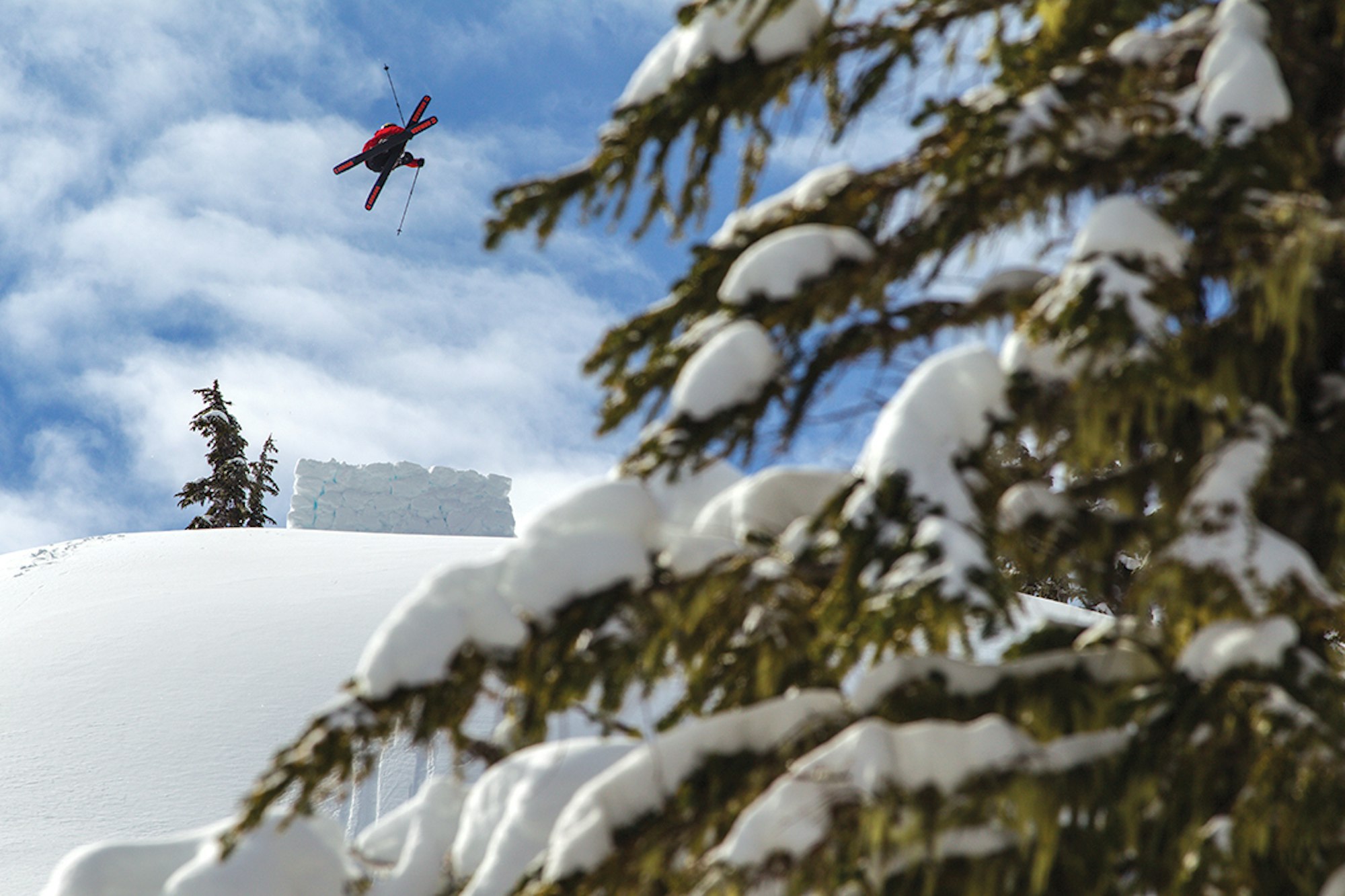
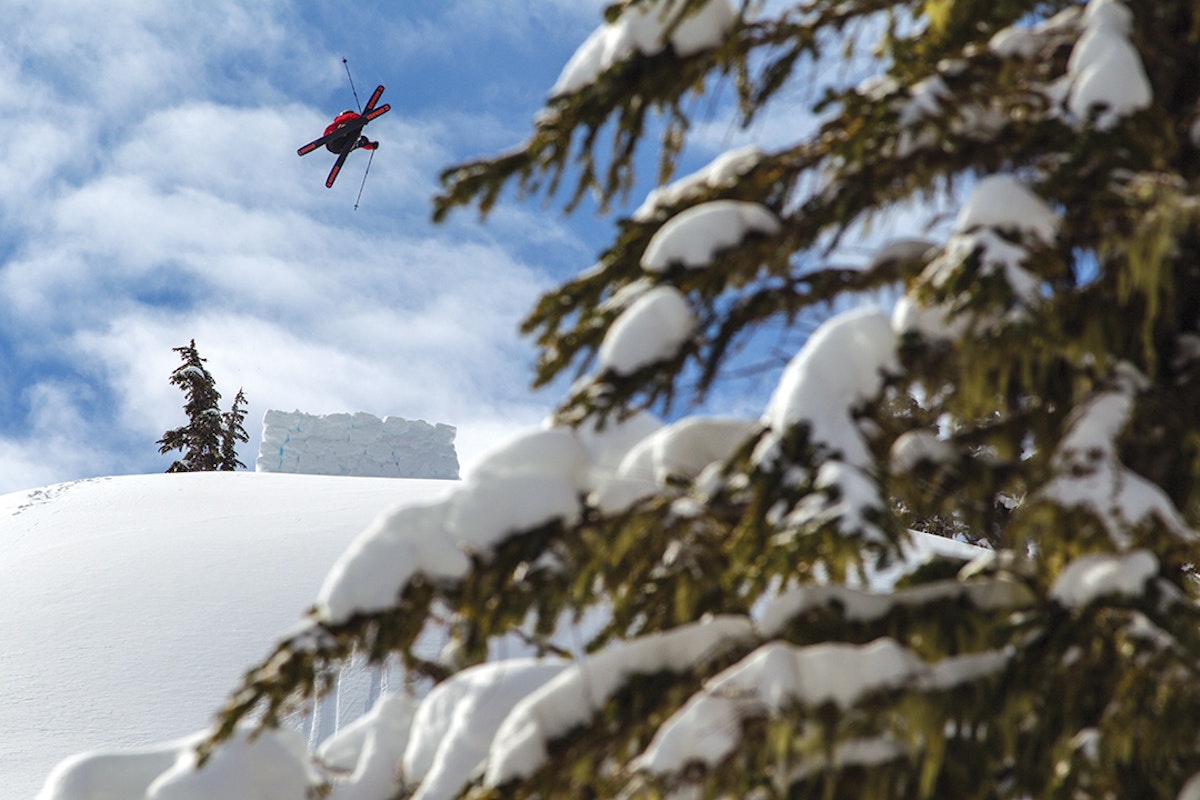
We used the info we’d gathered to find a prime spot to build a couple of jumps. The takeoff zone was a large island with ample room for two kickers, each with a separate landing zone. Stoke was high as Bibby, Schiller and I discussed what tricks we had planned. As we waited for the snow on the jump to set, excitement about the upcoming session mounted. It’d been years since we’d hit a backcountry jump together, and we were starting with the biggest jump so far this season.
Unfortunately, things didn’t play out well at first. The landing had a tricky double rollover, and on our first few jump attempts, we all over-rotated and slammed hard. Soon enough though, we were getting the hang of things. Bibby continued to stomp, becoming more confident with each landing. He capped off his session with an amazingly large, clean cork 7 blunt. Bibby’s display pumped some energy into the group. Schiller mustered the balls to hit the jump switch, and after navigating the rolling, off-camber inrun at impressive speed, he managed a nice switch 5 with the effortless style he’s known for.
I continued to pummel myself into the ground. In hindsight, I should have called it quits, but I continued to hit the jump out of sheer anger. After suffering a few of the harder bails I’ve had in recent memory, I walked away with a successful 720 under my belt. We went home stoked and sore. We knew that we’d have to head out again the next day or run the risk of seizing up on account of all that body slamming. This was not an option given we had another week ahead of us.
We continued north from the Skeena River Valley along the Bear River to Stewart and Hyder. The Stewart-Cassiar Highway has the highest concentration of avalanche paths in North America and is constantly buried by massive slides. Fortunately, we didn’t encounter any.
Driving into Stewart was like stepping back in time. Once home to 10,000 during the gold rush of the early 1900s, the town currently has a population of less than 500. With only a couple of general stores and bars, the blue-collar town still boasts a rough and tumble vibe. It was clear to us that there were like-minded people there, though, as we saw brand new snowmobiles sitting in every other front yard.
Bibby and Hughes had spent time in Stewart before, so we knew what kind of terrain to expect—somewhat. Snowfall was in the forecast. The Salmon Glacier on the Alaskan side of Hyder was our destination. After getting the lowdown from some local guides, we decided that the high alpine zones above the Salmon River would be our best option for larger lines. So, off we went.
The border between Stewart and Hyder is home to the only unmanned border crossing from Canada into US territory. This meant we were free to enter the US unchecked and without documentation, but we would have to provide a passport for reentry to Canada through the Canadian border station. Knowing we had some questionable contents on board, we checked with the Canadian border guard to ensure we wouldn’t be detained upon reentry. The gentleman informed us that our guns were fine to take back and forth, but that if we had any fireworks, we would need to discharge or dispose of them before reentering British Columbia. We assured him that wouldn’t be a problem.
“The snow was amazing. The north face was sheltered, and it was late enough in the season that it was getting good sunlight. No one had expected to be skiing deep pillows in April.”
We unloaded the sleds along the Salmon and made the 4,300-foot climb to the alpine. Once there, it was evident that the most recent snow had fallen in conjunction with a large wind event. Where we had hoped to find powder, we instead found what resembled the top of a lemon meringue pie. Disappointed, we scoured the area looking for a suitable aspect. Eventually, we came across a large glacial feature in a hidden valley that held surprisingly good snow. Excited about our find, we made every possible use of it.
Getting up to the feature took a bit of cowboying on the sleds. We knew we could ghost ride our sleds back down for quicker laps, but to do so involved a hefty climb, fully pinned, until our sleds were slightly stuck. Then, we’d have to pull our skis off the rack, set the sled’s e-brake, and whip it around until it slid back towards the bottom of the valley. Nothing we couldn’t handle. We went for it. From that point, we donned skins and made our way through the seracs to the top of the drop-in.
It was a unique feature, offering near perfectly shaped takeoffs atop pillars of ice. After overcoming my nerves I skied into a blind rollover. My line quickly opened up and I could clearly see the lip of the jump. I set my 360 and aired between the walls of the glacier to my narrow landing. As I made my way up for a second run, my cross-valley vantage point was perfect for watching Bibby. Dropping in from the same point, he made effortless turns over the top of a hanging ice shelf, pushing slough over the edge with each slash. I was imagining Hughes’ shutter clicking away with each deep turn.
We were feeling great, finally putting some solid tracks down in the high alpine. Each successful run-through provided us a much-needed boost in morale after tough times with weather and snow conditions. Out of celebration and obligation, we thought it would be fitting to blast the shotguns and fireworks at the trailhead. We took aim at some clay pigeons from the back of the sled deck.
We made a memorable stop at the Hyder General Store to pick up some souvenirs. Owner and full-time Hyder resident, Wes, shared stories of locals being eaten by grizzlies and shoplifters getting beat up on the front steps of the store. He also declared his love for the local garbage scavengers, two bears named Shithead and Asshole. Wes showed us his handguns, and Schiller purchased a Hyder hoodie before we were on our way back to BC.
The rough weather and accompanying crap snow conditions continued. The storm slated to hit Stewart had shifted south to Terrace, so it was back in the trucks for round two in the Skeena River Valley. At this point, we were feeling slightly stressed. We had hoped to log our best shots of the year but weren’t quite satisfied with our results. Collectively, we had to make some tough calls and step away from some impressive terrain. Backing down from lines can be hard to do, but we weren’t about to push the safety factor. With many years of backcountry knowledge among our close-knit group, we felt good about our decisions.
Always mindful of the snow stability, we arrived at a new, manageably safe ridgeline, home to some of the nicest pillow features I’d seen all year. With much of the access too tightly treed to sled, we set the skin track. Not before I had torn the hood and dash off of my sled though—the result of sending it into said tight trees. Nothing a little duct tape couldn’t take care of.
“Knowing we had some questionable contents on board, we checked with the Canadian border guard to ensure we wouldn’t be detained upon reentry.”
The snow was amazing. The north face was sheltered, and it was late enough in the season that it was getting good sunlight. No one had expected to be skiing deep pillows in April. We lapped the face all day, spotting line after line. We skinned up together and hyped each other up at the top of every drop spot. With each ski, we gained more confidence and moved into larger pillow lines. Schiller stepped up to what was likely the largest stack of the trip. He stood atop his line, providing a sense of scale. What we originally thought to be 5-10 foot drops between pillows was actually twice that.
Dropping in, he managed the first few pillows and drops like a veteran. The last and largest of the pillows sent him flying well over 20 feet to his landing below. He came in square for a classic four-point landing, but the pitch was simply too flat. Tomahawking down the slope, he finally came to a stop, discouraged but ready for another go. Schiller’s next drop paralleled his first, but he steered clear of the ill-fated pillow towards the bottom. He cleaned it flawlessly.
The day was exactly what we had hoped for when we planned the trip—a full session, cheering on your buds as you rip up a new zone. We loaded the sleds up and made our way down to the river to get our lines wet. With a large fire burning, we threw some casts and enjoyed a few beers. With the fishing proving slow and the river not producing, we abandoned our goal of landing a famed steelhead trout the region is widely known for. We moved our attention to the fire. As we were letting off fireworks and messing with the flames, Tanner mentioned something about a “piss bomb.” And with a name like that, he had our attention.
He listed off the necessary ingredients, including a 26-ounce glass bottle, gasoline and urine. We ran back to the truck to gather the first of those ingredients. We ended up assembling several jerry cans. Considering that we had five guys who’d been drinking beer all afternoon, we had a piss bomb assembled in a matter of minutes. Tanner screwed the cap on and set it on the fire. “Step back,” he said as we anxiously awaited the result. The bottle of piss came to a rolling boil, then boom! A 30-foot-tall flame of gasoline and piss erupted out of the bottle and lit the forest up momentarily like some kind of napalm gun. Amazement and laughter ensued, and we immediately started looking for another bottle.
With a successful day in the books and more terrain in the pillowed area to explore, we headed back in with our sights set on bigger prospects. At this point, we were sending the heaviest lines of the trip. Bibby stepped up to a narrow, pillowed spine. It was long and exposed with cliffs on either side. He skied it with confidence and finesse, hitting each pillow with an airplane-style turn and finishing off by airing a hefty drop over trees to the firm, sloughed snow of the apron. There was hollering and stomping all around. We were pushing ourselves and feeding off one another just like we did skiing together as kids. Morale was high, and we started to feel like all the patience displayed earlier on the trip was paying off.
Knowing we had little time left in the area, we hiked our asses off, eager to tag every spot possible. One line in particular caught my eye: a large pillow stack with a prominent ramp midline. After viewing the takeoff from various angles, I felt I could air over the remaining pillows. Once on top, I could see each pillow leading up to my ramped takeoff. I navigated the first three drops and gained speed heading into the lip. I set what was one of the largest natural 360s I’ve ever done. I had plenty of time in the air to look around and see the pillows below me. I rotated around and set down for my landing, tapping the edge of the last pillow with my tails. I caught a tiny transition on the underside and rode away through a massive powder cloud. I skied down to the group for a round of high fives. We started our descent to the trucks with an air of relief and accomplishment. The last days of our trip brought the level of skiing and excitement we’d hoped for the whole time. It was the perfect finish. We’d be driving home happy.
We packed up and moved out of the Bear Country Inn, leaving the Skeena River Valley with top-notch memories to show for our efforts. Not to mention some great photographs.
During the final days of the trip, we had put it all on the table. I wouldn’t say conditions were epic, but we had everything we’d wanted in a great ski trip: a close group of friends, a whole lot of adventure and perseverance, some deep days, big jumps, big pillows and a few good afternoons down by the river, too.
Related: Turbo Pow: Short term weather forecasting for nipple deep turns
Note: This article appears in FREESKIER magazine Volume 17.4, The Backcountry Issue. The issue is available via iTunes Newsstand. Subscribe to FREESKIER magazine .

![[GIVEAWAY] Elevate Your Ski Season With a Custom Ski Boot Upgrade from Surefoot](https://www.datocms-assets.com/163516/1790362417-surefoot-remedy130-leaderboard-2240x1520.jpg?w=200&h=200&fit=crop)