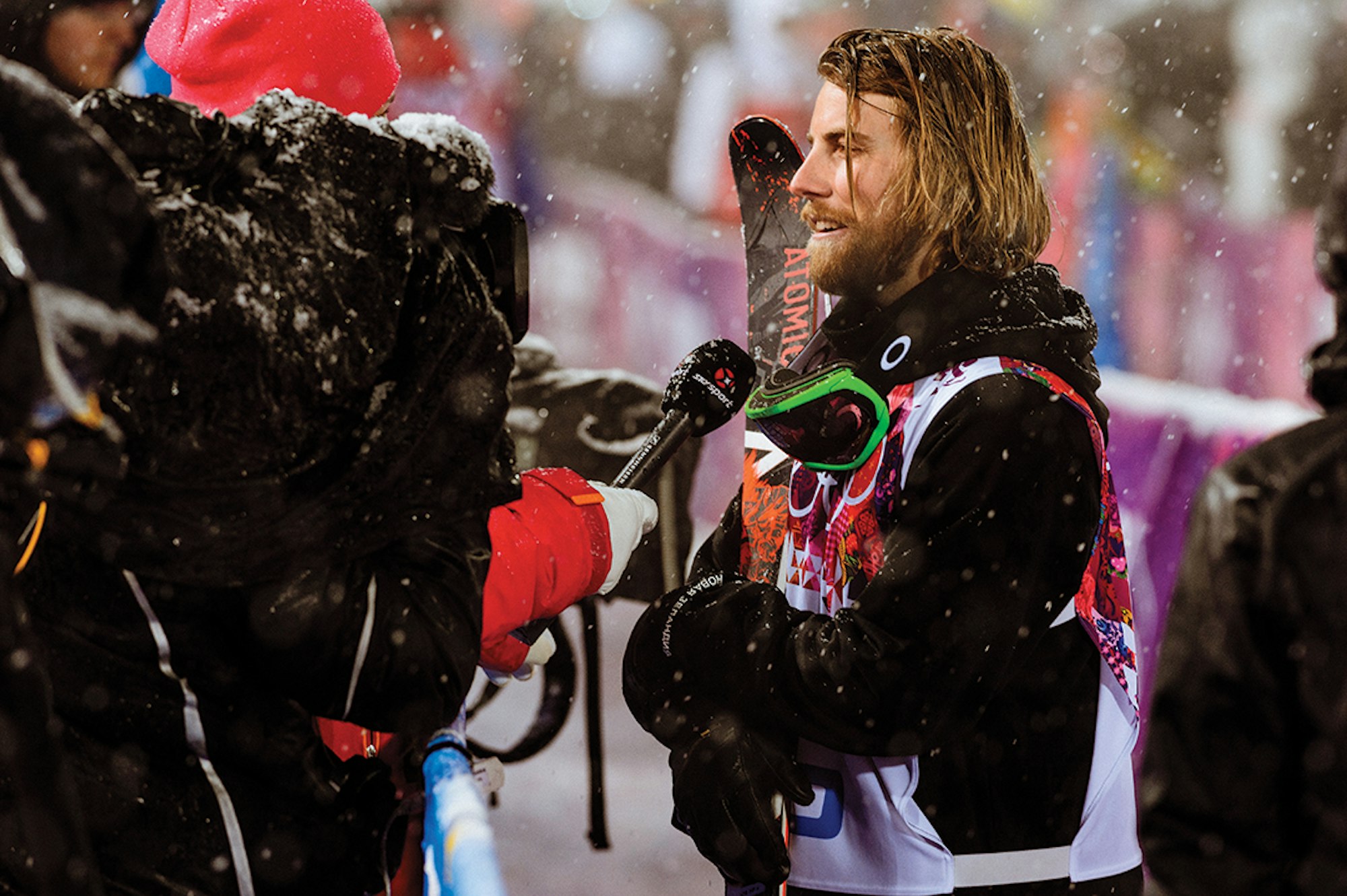

[juicebox gallery_id=”231″]
Watching sports agent Michael Spencer while one of his athletes competes is almost as exciting as spectating the event itself. Spencer’s piercing blue eyes settle on the course and narrow in intensity. As he paces back and forth, his gloved hands come together with such force, they create a loud thwap through layers of insulation. His repetitive shouts of support— “Come on, [insert athlete name], come on!”—rise above even the loudest X Games crowd. It’s the only way he knows how to release the nervous energy that overcomes him at every high- stakes event. Spencer might turn red in the face, and he might lose his voice, but if you are a high-profile skier, he’s just the kind of guy you want negotiating your contract.
$ $ $
As vice president of action sports and Olympics at Wasserman Media Group , Spencer manages the largest roster of any agent in freeskiing: Simon Dumont, Gus Kenworthy, Torin Yater-Wallace, Jossi Wells, Byron Wells, Kelly Sildaru, Justin Dorey and Lyman Currier. He’s also been in the game the longest. He signed Dumont in 2003, when Tanner Hall was the only other skier with an agent. The 43-year-old holds a law degree and lives in Park City with his wife and two young daughters. His intensity doesn’t surface until it needs to—say, one of his athletes is on the cusp of qualifying for the next round or losing a major sponsorship deal.
Before Dumont ever climbed atop a major podium, he hired Spencer to secure brand partnerships and endorsement opportunities and to negotiate his contracts. More than a decade later, Dumont credits Spencer for much more than securing his salary. “He’s like a father to me,” says Dumont. “He’s kept me as grounded as he could and always pointed me in the right direction. He helped mold me into what I am today.”
In the last ten years, sports representation in freeskiing has gone from unheard of to commonplace. Chairlift deals between ski companies and parents have evolved into 15-page, six-figure contracts from the legal desks of car and energy drink companies, making the role of the ski agent indispensible for athletes in the sport’s upper echelon. The role is evolving as quickly as the sport, but the agent’s primary responsibility remains the same—deal with the business side so their clients can focus on skiing.
When Tom Yaps, an agent for Evolution Management & Marketing , signed Tanner Hall in 2006, 95 percent of his job was finding endorsement deals. Over the years, Yaps has helped produce Hall’s films with Eric Iberg and Inspired Media Concepts, as well as the Tanner Hall Invitational. When he started working with Tom Wallisch in 2009, Yaps founded TW Media to produce The Wallisch Project , for which he secures funding and distribution deals and runs the books, taxes and contracts.
Watch: “The Wallisch Project”
“I like his laid back approach,” says Wallisch. “He’s somebody I can easily talk to, hang with and be around, and he also does a good job on the business side of stuff. But really, he’s more of a good friend.”
Yaps studied sports business in grad school at New York University, then went to work for SFX in the talent marketing department, where he met his current business partners. Yaps co-founded Evolution Marketing & Management in 2005 when he signed his first client—Sarah Burke. He signed Hall shortly thereafter. In addition to Hall and Wallisch, Yaps currently manages Nick Martini, Mike Riddle, Maddie Bowman, Maggie Voisin, Willie Borm, Colby Stevenson and Andy Partridge.
Amy Stanton, the Santa Monica, CA-based founder and CEO of Stanton Company , got into the business through her work with snowboarder Gretchen Bleiler, whom she still represents. She signed Kristi Leskinen in 2008 and now manages two skiers, Grete Eliassen and Brita Sigourney. With a background in traditional marketing, Stanton works to build brands around her athletes—brands that extend beyond the industry.
“My goal is to represent radically different personalities,” says Stanton. “But they all have a desire to do more than just excel in their sport, they want to have a positive impact and give back.”
She says the traditional sponsorship model has changed and that most athletes can’t rely on their contracts alone to make a living. Stanton encourages her clients to develop skills in different areas. For example, Eliassen has graduated from the University of Utah and worked in a governor’s office as well as with the Women’s Sports Foundation. “She’s developed a skill set beyond skiing, which is a great model for athletes to follow,” says Stanton.
Though more and more agents have popped up in the freeskiing scene, the profession requires a specific skill set. Negotiation skills are obviously a must. And when you hear agents claim, “It’s all about relationships,” it’s true.
“It helps when you have a personal relationship with people at the brands,” says Yaps. “You know who’s going to be honest and whether there’s any wiggle room— basically being able to read people when they say, ‘This is the most I can offer.’”
A legal background helps, too. Spencer says high-profile athletes need almost 24/7 access to an attorney. “I’ve seen too many things go wrong when people have agreed to things they shouldn’t have,” he says.
The hours are relentless. For the most part, agents are available to their athletes around the clock. Spencer is in touch with all of his athletes on a weekly basis. In the past 11 years, the longest he’s gone without talking to Dumont? Five days.
Michael Svenningsen, founder of Sven Sports Management and Allegiance Sports Group, joined Spencer at Wasserman Media Group in October, bringing his roster of clients that includes Joss Christensen, Aaron Blunck, Alex Beaulieu-Marchand and Alex Schlopy. The 29-year-old New Jersey native met Peter Olenick in 2003, when they both attended the University of Colorado at Boulder. Olenick was coming off winning an X Games High Air gold medal and interested in finding nonendemic sponsors. He knew Svenningsen (or “Jersey” as he’s known to many) could fight his tough battles.
“Beyond just taking care of contracts, he was really hands-on at events,” says Olenick. “If I broke a binding, he’d scramble to get me new skis. He took it to a more personal level.” Olenick says agents make it easier to remain friends with team managers—it’s hard to negotiate with friends. But, says Olenick, when things become less personal, it’s also easier for team managers to drop athletes when they’re dealing with an agent instead of the athlete directly.
When it comes to nonendemic deals, most of the time is spent on the front end, educating the company and “getting them to buy into the sport,” says Spencer. While establishing a relationship might take years, nonendemic negotiations tend to be more straightforward than endemic deals, which generally are more time consuming.
When a company offers an athlete a contract, it typically outlines a salary, performance-based bonuses, social media obligations, appearances and more. “In my mind, I go in with this lump sum I’d like to get with a contract—say it’s $125,000 for athlete X,” says Spencer. “I go in knowing there’s no way they’re going to write a check for that amount. Ideally, I’d get skier X a $75,000 retainer and $50K in potential bonuses. Then I’d keep hammering and continue with the back and forth.”
Once the financial terms are solid, agents look at the intrinsic value of the contract and ask the athlete how much time they’re willing to commit. Athletes often sign one-, two- or four-year contracts—deals on either end of the spectrum are rare. Contract negotiations can take months and months of calls, emails and usually at least one face-to-face meeting.
“I’ve had negotiations last several months or take literally 10 minutes over a beer,” says Chris Adams, promotions director for Marker-Völkl. In 2011, after noticing Emilia Wint while lapping the park at Breckenridge Ski Resort, Adams hopped on the lift with her and asked if she had a ski sponsor. Wint laughed and Adams asked if she wanted to ski on Völkl. He flowed her product and then signed an official contract with her less than a year later. Wint now has professional representation.
Adams says he started noticing more agents coming into the picture around 2006. His first taste was a sour one—as soon as one of Völkl’s top halfpipe skiers hired an agent, the skier left the company and joined forces with another brand. But, says Adams, agents serve a valuable purpose in helping athletes manage expectations and securing nonendemic opportunities that help Völkl’s athletes gain mainstream exposure. Echoing Olenick’s comments, Adams agrees that agents also somewhat insulate the athlete and help ensure the team manager-athlete relationship remains friendly. Now, agents represent about half of Völkl’s freeski athletes.
“When it comes to top-tier talent, I don’t mind negotiating with professional agents,” says Adams. “They’re hard negotiators, but they’re also fair. If they ask for a premium, they expect me to push back and require more from their client.”
In a lifestyle sport like skiing, what a lot of these business relationships come down to is who you want to grab a drink with at the end of the day. After all, agents and athletes spend a substantial amount of time together. Sean Pettit refers to his agent, Jaimeson Keegen, as “Uncle Jamo.”
“Becoming a business owner, a homeowner and managing being a pro skier can feel like a lot at once,” says Pettit. “That’s why I have Jaimeson. He’s my management. He’s my brains, he’s my ideas guy and he’s most definitely my friend.” Pettit adds, “An agent is essential for my situation so I can focus on the most important thing I do, which is skiing.”
“It’s a total family vibe,” says Keegan, who is based in Seattle. Keegan took the relationships he developed while working at Red Bull from 1999-2009, and founded Superheroes Management , an athlete and entertainment talent agency. “From time to time, people like Sean would ask me my opinion about their careers,” says Keegan. “I realized I could be of value to them in an official capacity.”
He signed Pettit in 2009 and Bobby Brown in 2010. Now, his roster spans the action sports world. Keegan says he likes his position on the cutting edge of the industry. “Athletes hear about things first. They dish us information, and then we’re feeding it to the business side,” he says.
Spencer says agents also have a responsibility to help grow the sport of skiing along with their athletes. “It’s not just the idea of making athletes a lot of money, but the legacy of the sport,” he says. That’s why Spencer helped form the Association of Freeskiing Professionals, which implemented the global rider ranking system and aims to provide a unified voice for freeskiing.
In a sport where injury runs rampant and careers don’t last long, responsible representation focuses on the long term. The ultimate agent not only helps an athlete achieve his or her athletic goals but also sets them up for a successful life beyond skiing.
Note: This article appears in FREESKIER magazine Volume 17.6. The issue is available via iTunes Newsstand. Subscribe to FREESKIER magazine .
Related: Speak softly and carry a big medal: Joss Christensen’s humble rise to recognition